|
Getting your Trinity Audio player ready... |
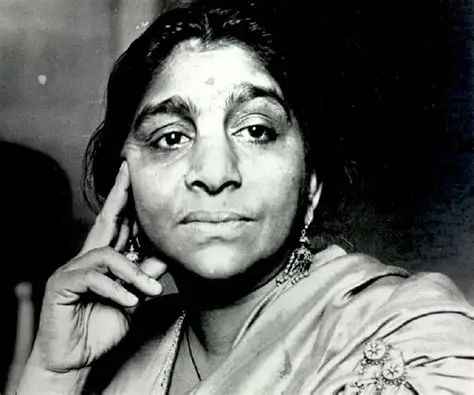
Sarojini Naidu was an Indian poet, nationalist, political leader, and advocate for women’s participation in public life. Born in Hyderabad in 1879, she became one of the most recognizable voices of India’s independence movement. Her lyrical poetry earned her the title “Nightingale of India,” while her political career placed her among the leading figures of the Indian National Congress.
Naidu combined literary talent with political activism at a time when Indian women faced major restrictions on public participation. She campaigned for self-government, women’s rights, communal harmony, and India’s independence from British rule. After independence in 1947, she became Governor of the United Provinces, making her the first woman to hold a gubernatorial position in independent India.
Early Life and Family Background
Sarojini Naidu was born Sarojini Chattopadhyay on February 13, 1879, in Hyderabad. Her father, Aghornath Chattopadhyay, was a scientist, educator, and the founding principal of Nizam College. Her mother, Barada Sundari Devi, was a Bengali poet who wrote in Bengali. Sarojini grew up in an intellectually active household where education, literature, science, and political discussion were valued.
Her family produced several notable intellectuals and activists. Her brother Virendranath became an important revolutionary nationalist, while her younger brother Harindranath became a poet, playwright, actor, and politician. The family’s Hyderabad residence became a meeting place for discussions about education, reform, nationalism, and public affairs.
Sarojini demonstrated exceptional literary ability while still very young. Her talent attracted attention beyond Hyderabad and eventually helped her obtain opportunities for advanced education abroad.
Education and Literary Beginnings
Naidu studied in Hyderabad before entering the University of Madras system for her matriculation. Her academic performance earned her a scholarship from the Nizam of Hyderabad, allowing her to travel to England in 1895.
She studied first at King’s College London and later at Girton College, Cambridge. Her years in Britain exposed her to European literary circles and broadened her understanding of poetry. She also encountered writers who encouraged her to develop a distinct Indian voice rather than simply imitate English literary traditions.
Edmund Gosse, an influential English critic, became an important early literary adviser. He encouraged her to draw more deeply from Indian settings, images, traditions, and experiences. That direction became important to the development of her mature poetry.
Poetry and Literary Career
Sarojini Naidu’s poetry combined musical language with images drawn from Indian life. Her poems explored love, nature, sorrow, patriotism, religious harmony, and everyday occupations. She wrote in English but filled her work with Indian landscapes, cultural references, festivals, occupations, and symbols.
Her first major poetry collection, The Golden Threshold, appeared in 1905. The collection established her literary reputation and later gave its name to the Hyderabad residence associated with her family. The University of Hyderabad now preserves the building as an important part of her legacy.
Her second major collection, The Bird of Time, was published in 1912. It contained poems that demonstrated her growing interest in Indian identity and public life. The Broken Wing, published in 1917, included strongly patriotic poetry and reflected her developing commitment to India’s national movement.
Her literary reputation eventually became inseparable from her political identity. Poetry gave her a public voice, while nationalism gave that voice a broader purpose.
Entry into Indian Politics
Naidu’s political involvement expanded during the early twentieth century. The growth of Indian nationalism, particularly after the partition of Bengal in 1905, influenced her increasingly active public role. She traveled widely, addressed meetings, and spoke about political freedom, women’s rights, and social unity.
She developed relationships with leading nationalists, including Gopal Krishna Gokhale and Mahatma Gandhi. Gokhale encouraged her political development, while Gandhi’s philosophy of nonviolent resistance later became central to her activism.
Naidu also became an important advocate for women’s political participation. She argued that India’s freedom movement could not be separated from the advancement of Indian women. Her speeches often emphasized national unity across religious and social divisions.
Freedom Movement and Congress Leadership
Naidu became increasingly involved in the Indian National Congress and the wider campaign for self-government. In 1915, she delivered speeches supporting self-government and emphasized unity among India’s different religious communities. Her poem “Awake,” associated with this period, expressed the nationalist ideals that increasingly characterized her public work.
In 1925, Naidu became president of the Indian National Congress at its Kanpur session. She was the first Indian woman to hold the presidency of the organization. Annie Besant had previously become the first woman Congress president in 1917, making Naidu’s achievement part of a developing tradition of women’s leadership within the movement.
Naidu participated in Gandhi’s campaigns of civil disobedience and nonviolent resistance. During the Salt Satyagraha, she took an active leadership role after Gandhi’s arrest. British authorities imprisoned her several times because of her nationalist activities.
Her commitment continued during the Quit India Movement of 1942. She was arrested along with Gandhi and other Congress leaders and held at the Aga Khan Palace. Her imprisonment lasted several months, and deteriorating health contributed to her release in March 1943.
Sarojini Naidu as Governor
India achieved independence from British rule on August 15, 1947. Naidu entered the new political order as Governor of the United Provinces, the region later known primarily as Uttar Pradesh. She became the first woman governor in independent India.
Her appointment demonstrated the transition of women who had participated in the freedom struggle into positions of constitutional responsibility. She remained active in public affairs while also maintaining her reputation as a poet and speaker.
Her governorship was relatively brief because she died less than two years after independence. Nevertheless, the appointment became an important milestone in the history of women in Indian public life.
Personal Life and Family
Sarojini married Govindarajulu Naidu, a physician, in 1898. Their marriage crossed regional and social boundaries and reflected the family’s relatively progressive outlook. They had four children: Jayasurya, Padmaja, Randheer, and Leelamani.
Padmaja Naidu later became a prominent political figure and served as Governor of West Bengal. Through her children and wider family, Sarojini’s influence continued into India’s post-independence public life.
Death
Sarojini Naidu died on March 2, 1949, in Lucknow while serving as Governor of the United Provinces. She was 70 years old.
Her death came only about eighteen months after Indian independence. By then, she had experienced several major stages of India’s modern history, from colonial education and early nationalism to mass civil disobedience and independence.
Legacy and Historical Significance
Sarojini Naidu’s historical importance rests on the combination of her literary and political achievements. She demonstrated that poetry could provide a powerful cultural expression of national identity while public leadership could expand women’s participation in India’s independence movement.
Her poetry remains an important part of Indian English literature, particularly for its treatment of Indian landscapes, cultural life, love, patriotism, and human emotion. Her political career also established a visible example of female leadership within both the nationalist movement and the institutions of independent India.
Her legacy therefore extends beyond the title “Nightingale of India.” She was a poet who entered politics, a nationalist who advocated women’s participation, and a freedom fighter who later served in India’s constitutional government. Her life connects India’s literary history with its struggle for independence and the emergence of women in national leadership.
Frequently Asked Questions
Who was Sarojini Naidu?
Sarojini Naidu was an Indian poet, independence activist, political leader, and the first woman governor of an Indian state after independence.
Why was Sarojini Naidu called the Nightingale of India?
She earned the title because of the musical quality and lyrical character of her poetry. Her poems often celebrated Indian culture, nature, love, and patriotism.
What was Sarojini Naidu’s most famous poetry collection?
The Golden Threshold, published in 1905, was her first major collection. Other important collections include The Bird of Time and The Broken Wing.
Was Sarojini Naidu the first woman president of the Indian National Congress?
She was the first Indian woman to become Congress president. Annie Besant had become the first woman to hold the position in 1917.
When did Sarojini Naidu become governor?
She became Governor of the United Provinces after India’s independence in 1947 and served until her death in 1949.
When did Sarojini Naidu die?
Sarojini Naidu died on March 2, 1949, in Lucknow at the age of 70.
Conclusion
Sarojini Naidu’s life brought together literature, nationalism, women’s participation, and public leadership. From her early achievements as a poet to her role in India’s freedom movement and later service as governor, she occupied a distinctive place in modern Indian history. Her poetry preserved a rich literary expression of Indian life, while her political work helped expand the visible role of women in the struggle for independence and in the institutions that followed it.