|
Getting your Trinity Audio player ready... |
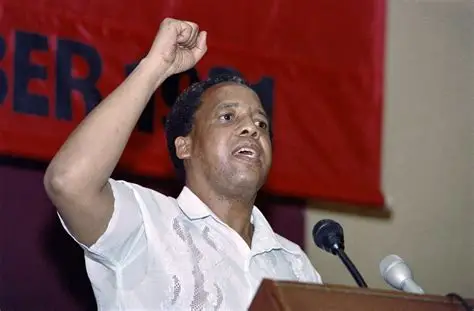
Chris Hani was a South African anti-apartheid activist, military commander and political leader. He became one of the most prominent figures in the struggle against white minority rule. As chief of staff of Umkhonto we Sizwe, the armed wing of the African National Congress (ANC), he helped organise the movement’s military activities. He later became general secretary of the South African Communist Party (SACP).
His assassination on April 10, 1993, shocked South Africa and threatened the country’s transition to democracy. Hani’s death came during negotiations to end apartheid, making it one of the most consequential political assassinations in modern South African history.
Early Life and Family Background
Chris Hani was born Thembisile Martin Hani on June 28, 1942, in Sabalele, near Cofimvaba in the Transkei region of South Africa’s Eastern Cape. He was one of six children born to Gilbert and Mary Hani.
His father worked away from home for extended periods to earn a living. This experience exposed Hani to the economic inequalities that affected Black South African families. His mother carried much of the responsibility for raising the children.
Hani grew up in a Christian household and initially considered becoming a Catholic priest. His early education took place in Catholic schools. However, his interest in politics developed as he witnessed racial discrimination and the effects of apartheid policies.
In 1954, several of his teachers lost their jobs after protesting against the introduction of Bantu Education. The policy restricted educational opportunities for Black South Africans. This experience strengthened his opposition to the apartheid system.
Education and Political Awareness
Hani attended Matanzima Secondary School before continuing his studies at Lovedale College in the Eastern Cape. He completed his secondary education in 1958.
He later enrolled at the University of Fort Hare, where he studied from 1959 to 1961. The institution had become an important centre of African intellectual and political activity.
Hani developed an interest in Marxist ideas and the relationship between racial discrimination and economic inequality. He also studied literature and classical subjects.
He completed a Bachelor of Arts degree in Latin and English at Rhodes University in 1962. After graduating, he moved to Cape Town and began working as an article clerk at a legal firm. He did not complete his legal training because his political activities soon took priority.
Entry into the Anti-Apartheid Movement
Hani joined the African National Congress Youth League in 1957. He was influenced by the prosecution of ANC leaders during the Treason Trial and the growing resistance to apartheid laws.
His involvement in student and political activities introduced him to established anti-apartheid leaders, including Govan Mbeki and other ANC organisers.
In 1961, he joined the underground South African Communist Party. The following year, he became involved in Umkhonto we Sizwe, which the ANC had established in 1961 as its armed wing.
The organisation emerged after the government intensified its repression of peaceful protests and banned major liberation movements. It initially carried out acts of sabotage against government installations and infrastructure.
Hani became an active organiser in the movement. His political commitment eventually forced him to leave South Africa and continue the struggle from exile.
Military Career and Years in Exile
In 1963, Hani went underground and left South Africa for military training abroad. He received training in the Soviet Union before joining ANC military activities in southern Africa.
In 1967, he participated in the Wankie Campaign, a joint operation involving Umkhonto we Sizwe and Zimbabwe African People’s Union forces against the white-minority government of Rhodesia, now Zimbabwe.
The operation faced serious difficulties. Rhodesian security forces pursued the fighters, and several members of the group were arrested or killed. Hani escaped into Botswana but was detained there for approximately two years because of weapons-related charges.
He later returned to Zambia and continued his work with the liberation movement. His experience in the campaign influenced his views on military organisation and political leadership.
Hani spent several years in Lesotho, where he helped organise underground ANC structures and military operations inside South Africa. His growing influence made him a target of assassination attempts.
In 1982, he moved to Lusaka, Zambia, where the ANC maintained an important part of its external leadership. He became a member of the organisation’s National Executive Committee and later served as political commissar of Umkhonto we Sizwe.
In 1987, Hani became the organisation’s chief of staff. The position placed him at the centre of its military leadership during the final years of apartheid.
Leadership of the South African Communist Party
Hani’s political influence extended beyond the ANC’s military structure. He became a senior leader of the South African Communist Party and worked closely with its leadership.
In December 1991, he succeeded Joe Slovo as general secretary of the SACP. His appointment made him one of the most visible political figures in the anti-apartheid movement.
Hani attracted considerable support among young South Africans, particularly those who had grown frustrated with poverty, racial inequality and the slow pace of political change.
His speeches connected the struggle for political freedom with demands for economic justice. He argued that ending apartheid should also create opportunities for people who had suffered under the country’s discriminatory economic system.
Return to South Africa and Political Transition
The South African government lifted the ban on the ANC and SACP in February 1990. Hani returned to South Africa and became an influential figure in the political transition.
He supported negotiations to establish a democratic political system, although he remained critical of delays and compromises that he believed could weaken the liberation movement’s objectives.
In 1992, he stepped down as chief of staff of Umkhonto we Sizwe to concentrate on his responsibilities within the SACP.
His popularity made him an important voice during a tense period. South Africa was experiencing political violence, deep disagreements over the future constitution and resistance from groups opposed to majority rule.
Assassination of Chris Hani
Chris Hani was assassinated on April 10, 1993, outside his home in Dawn Park, Boksburg, near Johannesburg. He had returned home with his daughter when Janusz Waluś, a Polish anti-communist immigrant, shot him.
Clive Derby-Lewis, a Conservative Party politician, was also implicated in the murder. Both men were convicted and sentenced to death, although their sentences were later changed to life imprisonment.
Hani’s assassination caused widespread grief and anger. Large crowds gathered across South Africa, and many feared that the killing would trigger a wider conflict and derail negotiations.
Nelson Mandela addressed the nation and appealed for calm. Political leaders continued negotiations, and the country proceeded towards its first democratic national election in April 1994.
The Truth and Reconciliation Commission later considered the circumstances surrounding the assassination and the political violence of the period.
Chris Hani’s Legacy
Chris Hani remains an important figure in South Africa’s struggle against apartheid. His career combined political organisation, military leadership and public advocacy for economic equality.
His influence was particularly strong among young activists who viewed him as a representative of the liberation movement’s commitment to ending racial oppression.
His assassination exposed the dangers facing South Africa during its transition to democracy. It also demonstrated how political violence could threaten negotiations and deepen divisions within society.
South Africa continues to honour Hani through memorials, public institutions and commemorative events. Chris Hani Baragwanath Academic Hospital in Johannesburg bears his name, while Chris Hani District Municipality in the Eastern Cape also recognises his contribution.
His life remains closely connected to the history of the ANC, the South African Communist Party and the wider campaign for democratic government.
Frequently Asked Questions
Who was Chris Hani?
Chris Hani was a South African anti-apartheid activist, military commander and political leader. He served as chief of staff of Umkhonto we Sizwe and general secretary of the South African Communist Party.
When was Chris Hani born?
He was born on June 28, 1942, in Sabalele, near Cofimvaba in the Eastern Cape region of South Africa.
What was Chris Hani’s role in Umkhonto we Sizwe?
Hani joined Umkhonto we Sizwe in 1962. He later became its political commissar and chief of staff in 1987.
Who assassinated Chris Hani?
Janusz Waluś shot and killed Chris Hani outside his home on April 10, 1993. Clive Derby-Lewis was also convicted for his involvement in the assassination.
Why was Chris Hani’s assassination significant?
His death intensified political tensions during South Africa’s transition from apartheid. It raised fears of widespread violence and threatened negotiations leading to democratic elections in 1994.
When did Chris Hani die?
Chris Hani died on April 10, 1993, in Dawn Park, Boksburg, South Africa. He was 50 years old.