|
Getting your Trinity Audio player ready... |
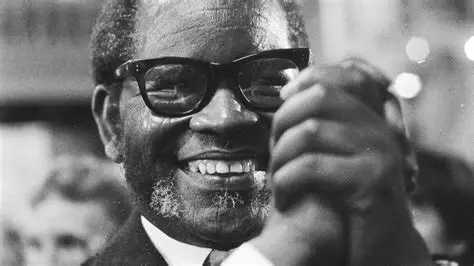
Oliver Tambo was a South African teacher, lawyer and anti-apartheid leader who helped guide the African National Congress (ANC) through decades of political struggle. He became the organisation’s president during its years in exile and built international support for the campaign against apartheid. His leadership helped preserve the ANC as a major liberation movement during a period of severe repression in South Africa.
Known widely as O.R. Tambo, he worked closely with Nelson Mandela, Walter Sisulu and other leaders who challenged racial discrimination. His political career combined legal advocacy, international diplomacy and the organisation of resistance against apartheid.
Early Life and Family Background
Oliver Reginald Kaizana Tambo was born on October 27, 1917, in Kantolo, near Bizana in Pondoland, Eastern Cape, South Africa. He grew up in a rural family that valued education and community responsibility.
His father, Mzimeni Tambo, was a farmer and trader. His mother was Julia Tambo. His family belonged to the Pondo community, whose history and traditions influenced his early upbringing.
Tambo attended local schools before enrolling at Holy Cross Mission School in Flagstaff. His family struggled to pay the fees, but financial assistance from supporters and relatives helped him continue his education.
He later attended St Peter’s Secondary School in Johannesburg. He performed exceptionally well academically and earned recognition for his achievements. His education gave him access to opportunities that many Black South Africans could not easily obtain under the racial restrictions of the time.
Education at Fort Hare and Teaching Career
Tambo enrolled at the University of Fort Hare, one of the few institutions offering higher education to Black South Africans during that period. He studied science, focusing on mathematics and physics.
At Fort Hare, he became involved in student politics. He supported demands for greater student representation and challenged university decisions that restricted student participation. His involvement in a protest over student governance led to his expulsion before he could complete further studies.
Despite this setback, Tambo continued his professional development. He qualified with a Bachelor of Science degree and pursued teacher training. He later returned to St Peter’s Secondary School, where he taught mathematics and physics.
His teaching career lasted several years. He earned respect for his academic ability and commitment to education. However, his growing involvement in the struggle against racial discrimination gradually drew him into full-time political work.
Founding the ANC Youth League
In 1944, Tambo became one of the founding members of the African National Congress Youth League (ANCYL). Other prominent founders included Nelson Mandela, Walter Sisulu and Anton Lembede.
The Youth League sought to strengthen the ANC and encourage a more active campaign against racial discrimination. Its members wanted greater political participation among young Africans and supported organised resistance to white minority rule.
Tambo served as the league’s first secretary. He later joined the ANC’s national leadership and became an important organiser within the movement.
His political work brought him into close partnership with Mandela. The two men shared a commitment to challenging apartheid laws and defending the rights of Black South Africans.
Legal Career and Partnership with Nelson Mandela
Tambo qualified as an attorney in 1951. The following year, he joined Nelson Mandela to establish a legal practice in Johannesburg.
Their firm, Mandela and Tambo, became one of the first Black legal partnerships in South Africa. It provided legal assistance to Black people who faced discrimination, police harassment and other abuses under apartheid legislation.
Many clients could not afford expensive legal representation. The firm therefore became an important source of support for people affected by the racial laws.
Tambo’s legal work strengthened his understanding of the country’s political and judicial systems. It also exposed him to the daily consequences of apartheid, reinforcing his commitment to organised resistance.
As the government increased restrictions on ANC leaders, Tambo took on greater responsibilities within the organisation. He became its secretary-general in 1955 and later deputy president in 1958.
Leadership of the ANC in Exile
The South African government banned the ANC in 1960 following years of political resistance and growing confrontation. Tambo left the country that year to organise the movement’s activities abroad.
His departure marked the beginning of a long period in exile. He travelled extensively to build relationships with foreign governments, political organisations and international anti-apartheid groups.
After ANC president Albert Luthuli died in 1967, Tambo became the acting president. The movement formally elected him president at its 1969 Morogoro Conference in Tanzania.
He remained in the position until 1991. During these years, he worked to maintain the ANC’s organisational structure and secure international support for the liberation struggle.
Tambo established ANC missions in different countries and helped mobilise diplomatic pressure against the apartheid government. He encouraged international campaigns for sanctions, boycotts and the isolation of South Africa.
His leadership also involved difficult decisions about armed resistance. The ANC had established its military wing, Umkhonto we Sizwe, in 1961. Tambo supported the organisation’s military and political structures while continuing to pursue international support for a democratic South Africa.
International Campaign Against Apartheid
One of Tambo’s most important contributions was his ability to turn the anti-apartheid struggle into an international campaign.
He addressed governments, international organisations and solidarity movements. He argued that apartheid was not simply a domestic South African issue but a system of racial oppression that required global opposition.
Under his leadership, the ANC strengthened relationships with African countries, socialist states and other international partners. These connections helped the movement maintain its activities despite restrictions inside South Africa.
Tambo also encouraged campaigns demanding the release of political prisoners, including Nelson Mandela. The Free Mandela campaign became a major part of international opposition to apartheid during the 1980s.
His diplomatic efforts helped increase pressure on the South African government. International sanctions, cultural boycotts and political isolation became important elements of the wider struggle against apartheid.
Return to South Africa and Final Years
In 1990, the South African government lifted the ban on the ANC and began negotiations that eventually led to the end of apartheid. Tambo returned to South Africa in December that year after spending three decades in exile.
His health had weakened following a stroke in 1989. Although he remained involved in political activities, he could no longer perform all his previous responsibilities.
At the ANC’s 1991 conference, Nelson Mandela became president of the organisation. Tambo received the position of national chairperson in recognition of his service.
He also became chancellor of the University of Fort Hare in 1991. The appointment reflected his lifelong commitment to education and his connection with the institution where his political journey had developed.
Oliver Tambo died on April 24, 1993, in Johannesburg, South Africa. He was 75 years old. His death came one year before South Africa held its first democratic national election under universal adult suffrage.
Oliver Tambo’s Legacy
Oliver Tambo remains one of the central figures in South Africa’s struggle against apartheid. His leadership helped preserve the ANC during decades of exile, political repression and international conflict.
His diplomatic work expanded global opposition to apartheid and helped secure support for South Africa’s liberation movement. He also contributed to the development of a political organisation capable of participating in the country’s transition to democracy.
Tambo’s legacy extends beyond his role as an ANC president. His early work as a teacher and lawyer reflected his belief in education, justice and equal opportunity. His partnership with Nelson Mandela also became an important part of the history of South African political resistance.
South Africa continues to honour his contributions through public institutions, monuments and educational programmes. Oliver Tambo International Airport in Johannesburg bears his name, while the Oliver and Adelaide Tambo Foundation preserves his memory and promotes his values.
His life demonstrates the importance of organisation, diplomacy and sustained leadership in the struggle for political freedom.
Frequently Asked Questions
Who was Oliver Tambo?
Oliver Tambo was a South African teacher, lawyer and anti-apartheid leader. He served as president of the African National Congress during much of its period in exile.
When was Oliver Tambo born?
He was born on October 27, 1917, in Kantolo, near Bizana in the Eastern Cape region of South Africa.
What was Oliver Tambo’s role in the ANC?
Tambo was a founding member and first secretary of the ANC Youth League. He later served as ANC secretary-general, deputy president and president from 1967 to 1991, with his presidency formally confirmed in 1969.
What was the relationship between Oliver Tambo and Nelson Mandela?
Tambo and Mandela were political colleagues and close associates. They helped establish the ANC Youth League and opened the legal practice Mandela and Tambo in Johannesburg in 1952.
When did Oliver Tambo die?
Oliver Tambo died on April 24, 1993, in Johannesburg, South Africa, at the age of 75.