|
Getting your Trinity Audio player ready... |
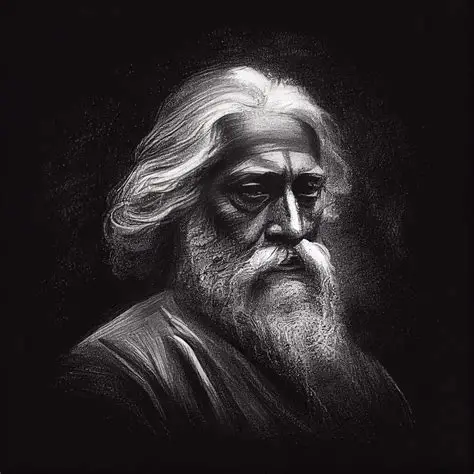
Rabindranath Tagore was an Indian poet, writer, philosopher, composer, educator, painter, and social thinker whose work reached far beyond Bengal. Born in Calcutta in 1861, he became the first Asian Nobel laureate when he received the Nobel Prize in Literature in 1913. His writing explored human relationships, nature, spirituality, freedom, education, and the relationship between India and the wider world.
Tagore was also an institution builder. He established an experimental school at Santiniketan and later founded Visva-Bharati, an educational institution designed to bring different cultures into intellectual contact. His literary achievements therefore formed only one part of a much wider legacy.
Early Life and Family Background
Rabindranath Tagore was born on May 7, 1861, in Calcutta, then part of British India. He was the youngest son of Debendranath Tagore, an important figure in the Brahmo Samaj, a reform movement influenced by the philosophical traditions of the Upanishads. Tagore grew up in the prominent Jorasanko Tagore family, which played an important role in the cultural life of nineteenth-century Bengal.
His childhood took place in an unusually intellectual environment. Music, literature, philosophy, theatre, painting, and social reform were all part of family life. Instead of following a conventional classroom education, Tagore received much of his early instruction at home.
He began writing poetry while still a child. His exposure to Bengali literature, classical Indian traditions, Western literature, music, and philosophical ideas later contributed to the distinctive character of his work.
Education and Formative Years
Tagore did not follow a conventional university education. His family arranged private instruction in several subjects, including Bengali, Sanskrit, English, history, science, and music. In 1878, at the age of seventeen, he travelled to England for further education.
He studied at University College London for a period but did not complete a formal degree. His time in Britain nevertheless broadened his knowledge of European literature and culture. He returned to India and continued developing his literary career.
In adulthood, Tagore also managed parts of his family’s estates in eastern Bengal. This responsibility brought him into direct contact with rural communities and agricultural life. The experience strengthened his interest in poverty, rural development, social reform, and the relationship between education and community welfare.
Literary Career and Major Books
Tagore wrote in many literary forms, including poetry, novels, short stories, plays, essays, memoirs, songs, and literary criticism. He wrote primarily in Bengali, although his later English translations introduced his work to readers outside India.
Among his important poetry collections were Manasi, Sonar Tari, Gitanjali, Gitimalya, and Balaka. His fiction included Gora, The Home and the World, and Yogayog. His plays included The Post Office, The King of the Dark Chamber, The Waterfall, and Red Oleanders.
Tagore’s short stories were equally important. He often examined ordinary family relationships, social customs, poverty, gender expectations, and conflicts between tradition and modernity. His characters frequently came from everyday Bengali society rather than elite political circles.
He was also a prolific composer. His songs became known as Rabindra Sangeet and remain an important part of Bengali cultural life. Tagore’s creative work therefore extended beyond books into music, performance, painting, and education.
Gitanjali and the Nobel Prize
Tagore’s international reputation grew dramatically after he translated selections of his Bengali poetry into English. The most famous collection was Gitanjali: Song Offerings, published in English in 1912. The English volume contained poems drawn from Gitanjali and other Bengali collections.
The English poems attracted considerable attention in Britain. Writers and intellectuals, including W. B. Yeats, helped introduce Tagore’s work to a wider Western audience.
In 1913, Tagore received the Nobel Prize in Literature. The Nobel Committee recognized his deeply sensitive and original poetry, which had helped bring his literary vision to readers beyond India. He became the first non-European Nobel laureate in literature and the first Nobel laureate from Asia.
The award transformed his international reputation. He travelled widely, giving lectures and meeting intellectuals across Europe, the Americas, and Asia. Yet he continued writing in Bengali and remained closely connected to Indian cultural life.
Tagore and Indian Nationalism
Tagore supported India’s aspiration for greater political freedom, but his nationalism differed from more narrowly political forms of nationalism. He was concerned that aggressive nationalism could create division and hostility between peoples. His political thought placed considerable emphasis on human dignity, cultural exchange, and international understanding.
He was associated with several figures in India’s independence movement, including Mahatma Gandhi. Their relationship involved intellectual disagreement as well as mutual respect. Tagore admired Gandhi’s moral influence but questioned some aspects of mass nationalism and political mobilisation.
The 1919 Jallianwala Bagh massacre profoundly affected him. Tagore had received a British knighthood in 1915, but he renounced the honour in protest against British policies following the massacre. His decision became one of the clearest public expressions of his opposition to colonial rule.
Santiniketan and Visva-Bharati
Education became one of Tagore’s most important lifelong projects. In 1901, he established an experimental school at Santiniketan. He wanted education to move beyond rigid classroom routines and encourage creativity, contact with nature, cultural understanding, and intellectual freedom.
The school developed into Visva-Bharati, founded by Tagore in 1921. Its purpose was broader than conventional academic instruction. Tagore envisioned a place where Eastern and Western intellectual traditions could meet through scholarship, art, language, and cultural exchange.
He also promoted rural reconstruction through Sriniketan, established in 1922. The project sought to help villagers address their own economic and social problems rather than imposing solutions from outside.
Visva-Bharati was later declared a Central University and an Institution of National Importance by an Act of Parliament in 1951.
Personal Life and Later Years
Tagore married Mrinalini Devi in 1883. They had five children, although two died at young ages. His family life was marked by several personal losses, including the deaths of his wife and children.
During his later years, Tagore continued writing, travelling, painting, and developing educational and cultural projects. He increasingly devoted himself to painting in his sixties, producing a substantial body of visual art.
His international travels also made him an important cultural representative of India. He met intellectuals and political figures in several countries and used these encounters to promote dialogue between cultures.
Death
Rabindranath Tagore died in Calcutta on August 7, 1941, at the age of 80. He had remained creatively active despite declining health during his final years.
His death marked the end of one of the most wide-ranging creative careers in modern Indian history. By then, his influence extended across literature, music, education, philosophy, painting, and cultural thought.
Legacy and Historical Significance
Rabindranath Tagore’s legacy rests on the unusual breadth of his achievements. He was not simply a Nobel Prize-winning poet. He developed a major body of Bengali literature, composed songs that remain culturally important, created educational institutions, promoted rural reconstruction, and encouraged intellectual exchange between cultures.
His educational experiment at Santiniketan became one of his most enduring contributions. Visva-Bharati preserved his idea that education could connect intellectual development with art, nature, community, and international understanding.
His literature also helped establish Indian writing in English translation as an important part of global literary culture. At the same time, his primary achievement remained his Bengali writing, which continued to influence generations of readers, writers, musicians, and artists.
Tagore’s national and international reputation has therefore survived because his work crossed several boundaries without being confined to one discipline. His life connected literature with education, cultural identity with internationalism, and artistic expression with social thought.
Frequently Asked Questions
Who was Rabindranath Tagore?
Rabindranath Tagore was an Indian poet, writer, philosopher, composer, educator, painter, and social thinker. He won the 1913 Nobel Prize in Literature.
When was Rabindranath Tagore born?
Tagore was born on May 7, 1861, in Calcutta, India.
What is Rabindranath Tagore famous for?
He is famous for his poetry, novels, short stories, songs, educational work, and the founding of Visva-Bharati. He is especially known internationally for Gitanjali and his 1913 Nobel Prize.
What was Tagore’s most famous book?
Gitanjali: Song Offerings became his best-known work internationally and played an important role in his receiving the Nobel Prize.
Did Rabindranath Tagore support Indian independence?
Yes. Tagore opposed British colonial rule and supported India’s freedom, although he also criticized aggressive forms of nationalism and emphasized international humanism. He renounced his British knighthood after the 1919 Jallianwala Bagh massacre.
When did Rabindranath Tagore die?
Rabindranath Tagore died on August 7, 1941, in Calcutta at the age of 80.
Conclusion
Rabindranath Tagore was one of the most influential figures of modern Indian cultural history. His poetry brought him the Nobel Prize, but his achievements extended into fiction, music, painting, education, rural reconstruction, and social thought. Through his literature and institutions, he developed a vision of India that valued cultural identity while remaining open to dialogue with the wider world.