|
Getting your Trinity Audio player ready... |
Introduction
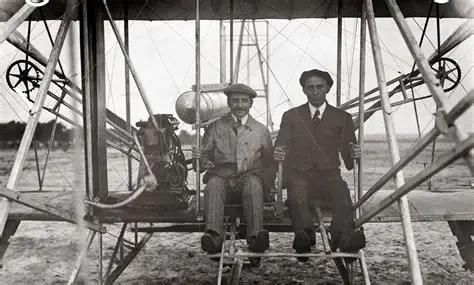
Wilbur and Orville Wright, popularly known as the Wright brothers, were American inventors and aviation pioneers who achieved the first successful powered flight of a heavier-than-air aircraft in 1903. Their breakthrough at Kitty Hawk, North Carolina, transformed a long-standing human dream of controlled flight into a practical technological possibility.
The brothers did more than build an airplane. Through years of experiments with gliders, wind-tunnel research, flight testing and mechanical design, they developed important principles of aircraft control and aeronautical engineering. Their achievement helped usher in the modern age of aviation and established their place among the most important inventors in modern history.
Early Life and Family Background
Wilbur Wright was born on April 16, 1867, near Millville, Indiana, while Orville Wright was born on August 19, 1871, in Dayton, Ohio. They were two of the children of Milton Wright, a bishop in the United Brethren Church, and Susan Catherine Koerner Wright.
The Wright family eventually settled in Dayton, Ohio, where Wilbur and Orville spent much of their childhood. Their father encouraged intellectual curiosity, while the family environment exposed the children to books, discussion and practical experimentation.
The brothers developed a close working relationship that would become central to their achievements. Although Wilbur was four years older, the two often worked together and shared an interest in mechanical problems.
Their interest in flight reportedly began when their father brought home a small toy helicopter powered by twisted rubber bands in 1878. The boys experimented with the toy and constructed their own versions, giving them an early introduction to the principles of flight.
Education and Early Interests
Neither Wilbur nor Orville followed the conventional path of completing a university education. Instead, much of their technical development came through independent reading, experimentation and practical work.
They showed an early interest in printing and mechanical technology. In the 1880s and 1890s, they operated a printing business in Dayton and became increasingly interested in machinery and manufacturing.
The brothers’ practical approach became an important feature of their later aviation work. Rather than relying entirely on established theories, they tested their assumptions through experiments and modified their designs according to the results.
Their ability to combine mechanical skill, business experience and scientific curiosity eventually helped them address problems that had defeated other aviation experimenters.
The Bicycle Business and Interest in Flight
In 1892, Wilbur and Orville opened a bicycle repair and sales business in Dayton. They later manufactured their own bicycles, including the Van Cleve and St. Clair models.
The bicycle business gave the brothers practical experience with mechanical construction, balance, chains, gears and precision manufacturing. These skills proved valuable when they began developing aircraft.
By the late 1890s, they had become seriously interested in aviation. The death of German glider pioneer Otto Lilienthal in 1896 particularly influenced their thinking. Lilienthal had conducted hundreds of gliding experiments and demonstrated that controlled flight was possible, although his fatal accident showed how much remained to be understood.
In 1899, Wilbur wrote to the Smithsonian Institution requesting publications about aeronautics. The information they received helped the brothers begin a systematic study of existing aviation research.
The Search for Powered Flight
The Wright brothers understood that building an airplane required solving several different problems. An aircraft needed sufficient lift, a reliable power source and, most importantly, a practical system for controlling movement in the air.
They began experimenting with kites and gliders before attempting to add an engine. Their early aircraft were tested at Kitty Hawk because the location offered wide open spaces, sandy terrain and dependable winds.
Their first full-scale gliders exposed weaknesses in the aerodynamic information available to them. Instead of abandoning the project, the brothers began conducting their own research.
In 1901, they constructed a small wind tunnel in Dayton. They tested numerous wing shapes and collected their own aerodynamic measurements. This work helped them correct inaccurate assumptions and improve the design of their next glider.
Their 1902 glider was a major breakthrough. The aircraft incorporated an improved system of control, including a movable vertical rudder, and the brothers completed hundreds of successful gliding experiments. Smithsonian records describe the 1902 testing as a crucial stage in their progress toward powered flight.
The 1903 Wright Flyer and First Flight
After establishing that their aircraft could be controlled, the brothers turned their attention to powered flight.
They designed and built an engine with assistance from their bicycle shop mechanic, Charles Taylor. The engine produced about 12 horsepower and was combined with two propellers driven through a chain-and-sprocket system. The Wrights also developed their own propeller designs because existing approaches did not adequately solve the problem of producing efficient thrust.
The resulting aircraft became known as the Wright Flyer.
On December 17, 1903, at Kitty Hawk, North Carolina, the brothers conducted four flights. Orville made the first successful flight at 10:35 a.m. The Flyer remained airborne for 12 seconds and traveled approximately 120 feet.
Three additional flights followed. The fourth and longest flight, piloted by Wilbur, covered about 852 feet in 59 seconds. The achievement demonstrated that a powered, heavier-than-air aircraft could take off, remain under control and fly with a pilot aboard.
The first Flyer was badly damaged later that day when strong winds overturned it. It was never flown again, but its historical importance was already established.
From Experiment to Practical Airplane
The 1903 flight was a breakthrough, but the brothers did not stop there. They continued developing improved aircraft in Dayton.
Their 1904 and 1905 machines became increasingly capable. On October 5, 1905, Wilbur completed a flight lasting 39 minutes and covering approximately 24.5 miles, demonstrating that their aircraft had progressed far beyond the brief flight at Kitty Hawk.
By 1908, the Wright brothers were demonstrating their aircraft in Europe and the United States. Their work attracted significant attention from governments and military organizations interested in the potential of aviation.
The U.S. Army eventually purchased a Wright aircraft, helping establish aviation as a technology with practical military and transportation applications.
The brothers subsequently established the Wright Company in 1909 to manufacture aircraft. Their work was becoming part of an emerging aviation industry rather than remaining a private experiment.
Major Achievements
First Successful Powered Airplane
The Wright brothers are best known for developing the first successful powered airplane capable of controlled flight with a pilot aboard. Their 1903 achievement marked a major turning point in transportation history.
Development of Aircraft Control
Their work was significant because they did not simply create an engine-powered machine. They developed methods for controlling an aircraft in flight, addressing problems involving roll, pitch and yaw.
Wind-Tunnel Research
The brothers used their own wind tunnel to collect aerodynamic data. Their approach demonstrated the importance of systematic testing in aircraft development and contributed to the foundations of modern aeronautical engineering.
Advancement of Aviation Technology
Their later aircraft demonstrated that powered flight could become repeatable and practical. Their work helped move aviation from experimental gliding toward a developing industry.
Wilbur Wright’s Death and Orville’s Later Years
Wilbur Wright died in Dayton on May 30, 1912, at the age of 45. His death came only a few years after the brothers had achieved international recognition for their aviation work.
Orville continued working with the Wright Company’s aviation interests and became increasingly concerned with preserving his family’s historical contribution to flight.
A dispute eventually developed between Orville and the Smithsonian Institution over historical claims concerning the first airplane. In 1925, Orville sent the original 1903 Flyer to the Science Museum in London after becoming dissatisfied with the Smithsonian’s presentation of the work of Samuel Langley.
The disagreement was eventually resolved. In 1948, the original Wright Flyer was placed on display at the Smithsonian, where it remains one of the most significant objects in the history of aviation.
Orville Wright died on January 30, 1948, at the age of 76.
Legacy and Historical Significance
The Wright brothers changed the course of transportation history by demonstrating that controlled, powered flight was achievable.
Their achievement emerged from years of patient experimentation rather than a single moment of inspiration. They studied the work of earlier aviation pioneers, identified weaknesses in existing knowledge, developed their own research methods and repeatedly tested their designs.
Their importance therefore extends beyond the first flight itself. The brothers helped establish an engineering approach to aviation based on experimentation, aerodynamic measurement and repeated flight testing.
The airplane eventually transformed travel, commerce, warfare, communication and international relations. What began as a fragile wooden aircraft at Kitty Hawk eventually developed into a global aviation industry connecting cities and continents.
The original 1903 Wright Flyer is now preserved at the Smithsonian National Air and Space Museum, where it remains a powerful symbol of the beginning of the aerial age.
The brothers’ legacy also demonstrates the importance of collaboration. Wilbur and Orville worked as partners throughout their aviation experiments, sharing ideas, responsibilities and technical discoveries.
Their story remains historically significant because they transformed an unresolved technological problem into a working machine. In doing so, they helped open an entirely new chapter in human history.
Read More: Plato Biography: Early Life, Philosophy, Major Works and Legacy
Frequently Asked Questions
Who were the Wright brothers?
The Wright brothers were Wilbur and Orville Wright, American inventors and aviation pioneers who developed the first successful powered airplane.
When did the Wright brothers make their first flight?
They made their first successful powered flight on December 17, 1903, at Kitty Hawk, North Carolina.
Who flew the Wright Flyer first?
Orville Wright piloted the first successful flight. The aircraft remained airborne for 12 seconds and traveled 120 feet.
How long was the Wright brothers’ first flight?
The first flight lasted 12 seconds. Their longest flight that day lasted 59 seconds and covered about 852 feet.
What did the Wright brothers invent?
They developed the first successful powered, controlled, heavier-than-air airplane and pioneered important methods of aeronautical engineering.
When did Wilbur Wright die?
Wilbur Wright died on May 30, 1912, in Dayton, Ohio.
When did Orville Wright die?
Orville Wright died on January 30, 1948, in Dayton, Ohio.
Why are the Wright brothers historically important?
They demonstrated that controlled powered flight was possible and helped establish the engineering principles that contributed to modern aviation.
Conclusion
Wilbur and Orville Wright transformed aviation through a combination of mechanical skill, scientific investigation and persistent experimentation. Their successful flight at Kitty Hawk on December 17, 1903, proved that a powered, heavier-than-air aircraft could be controlled in flight.
Their achievement became the foundation for an industry that would reshape transportation and modern society. The Wright brothers remain historically important not only because they flew the first successful powered airplane, but because their research helped establish the engineering principles that made sustained aviation possible.