|
Getting your Trinity Audio player ready... |
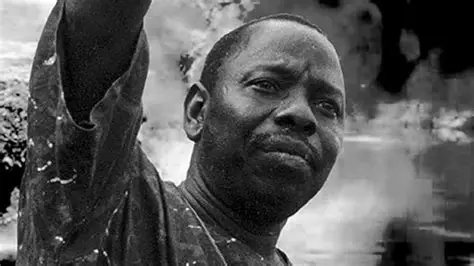
Ken Saro-Wiwa was a Nigerian writer, television producer, businessman and environmental activist whose campaign for the rights of the Ogoni people made him one of the most prominent voices in the history of the Niger Delta. Born in Bori in 1941, he combined literature with public advocacy, eventually leading the Movement for the Survival of the Ogoni People (MOSOP). His campaign challenged environmental damage, political marginalization and the distribution of oil wealth in Ogoniland. He was executed by the Nigerian military government in 1995 after a controversial trial, an event that brought international attention to the Ogoni struggle.
Early Life and Family Background
Kenule Beeson Saro-Wiwa was born on October 10, 1941, in Bori, in what is now Rivers State, Nigeria. He came from an Ogoni family and grew up in an Anglican household. His father, Chief Jim Wiwa, was a forest ranger and traditional title holder, while his mother, Widu, was a farmer and trader. His family background gave him a close connection with Ogoni society and its cultural traditions.
He received his primary education at a Native Authority school in Bori before attending Government College Umuahia. At school, he distinguished himself academically and in sports. He won prizes in subjects including English and History and served as captain of the table tennis team. His early academic success eventually earned him a scholarship to study at university.
Education and Early Career
Saro-Wiwa studied English at the University of Ibadan and graduated with honours in 1965. His university years developed his interests in literature, drama and public affairs. He edited student publications and participated in theatrical activities, experiences that helped establish the literary and communication skills that later became central to his career.
After university, he taught briefly and worked at the University of Lagos and University of Nigeria, Nsukka. He also became involved in public administration and business. His early professional life therefore crossed several fields, including education, government, commerce and writing.
Civil War and Public Service
The Nigerian Civil War changed the direction of Saro-Wiwa’s public career. He supported the Federal Government during the conflict and became Civilian Administrator of Bonny in 1968, an important oil-producing area in the Niger Delta. He later served as a commissioner in the old Rivers State, with responsibilities that included works, land and transport, education, and information and home affairs.
His experience in government exposed him to the political and economic importance of the Niger Delta. It also gave him firsthand knowledge of the tensions surrounding the region’s communities, resources and relationship with the Nigerian state. After leaving government, he increasingly concentrated on business and creative work.
Writing and Television Career
Saro-Wiwa became an accomplished writer whose work addressed Nigerian society, politics and everyday life. His early major publications included Songs in a Time of War, Sozaboy: A Novel in Rotten English and A Forest of Flowers. Sozaboy, published in 1985, used a distinctive mixture of Nigerian Pidgin and English to tell the story of a young man caught up in the Nigerian Civil War. The novel became one of his best-known literary works.
He also achieved enormous popularity through television. Saro-Wiwa created, produced and directed Basi and Company, a satirical series that examined greed, ambition and the pursuit of quick wealth in Nigerian society. The series ran from 1985 to 1990 and became one of the country’s best-known television productions.
His writing was therefore not separate from his public concerns. Literature, satire and journalism gave him ways to examine corruption, inequality, war and the social pressures affecting ordinary Nigerians.
The Ogoni Struggle and MOSOP
By the late 1980s, Saro-Wiwa had increasingly turned his attention to the conditions of the Ogoni people. Oil production had operated in Ogoniland since the late 1950s, while residents complained about environmental damage, inadequate infrastructure, limited political representation and the distribution of oil revenues.
In 1990, Saro-Wiwa became a leading figure in the Movement for the Survival of the Ogoni People. MOSOP articulated these concerns through the Ogoni Bill of Rights, which called for greater political autonomy, a larger share of oil revenues and protection of Ogoni land and water.
Saro-Wiwa emphasized nonviolent mobilization. In January 1993, MOSOP organized a major peaceful demonstration in which hundreds of thousands of Ogoni people participated. The movement’s pressure contributed to the withdrawal of Shell’s operations from Ogoniland later that year. The Goldman Environmental Prize subsequently recognized Saro-Wiwa in 1995 for his environmental and human rights work.
The campaign placed him in increasingly direct conflict with Nigeria’s military government. In 1993, he was detained over charges connected with his political activities. His activism continued despite repeated pressure from the authorities.
Arrest, Trial and Execution
In May 1994, four Ogoni leaders were killed during a period of intense political tension. Saro-Wiwa was arrested and charged with involvement in the murders, an accusation he denied. He and other Ogoni activists were tried before the Ogoni Civil Disturbances Special Tribunal established by the military government.
Human rights organizations raised serious concerns about the proceedings. Amnesty International described the prosecution as politically motivated and expressed concerns about the fairness of the trial, including the absence of an ordinary right of appeal. Nine defendants were eventually convicted and sentenced to death, while six others were acquitted.
Ken Saro-Wiwa and eight other Ogoni men were hanged on November 10, 1995. The executions generated widespread international condemnation and intensified scrutiny of Nigeria’s military government and the environmental situation in the Niger Delta.
Personal Life and Family
Saro-Wiwa married Maria, also identified in some biographical records as Nene Saro-Wiwa, in 1967. They had five children: Ken, Gian, Tedum, Noo and Nina. The children later continued aspects of his literary and public legacy, particularly through writing and advocacy concerning Nigeria and the Niger Delta.
His personal identity remained closely connected to Ogoniland. His writing, political activities and environmental campaign all drew heavily on his understanding of the region and its people.
Legacy and Historical Significance
Ken Saro-Wiwa’s historical importance rests on the connection he established between environmental protection, minority rights and political accountability. Before environmental justice became a widely used international framework, his campaign demonstrated how pollution and resource extraction could affect land, livelihoods, culture and political representation at the same time.
His literary legacy is equally significant. Sozaboy remains an important Nigerian novel, while Basi and Company demonstrated how television could address social problems through popular satire. His detention diary, A Month and a Day, provides a personal record of his imprisonment and the political pressures surrounding his final years. The National Library of Nigeria preserves the work as part of the country’s literary record.
The execution of Saro-Wiwa and eight other Ogoni activists also became a defining episode in the history of Nigeria’s Niger Delta. Amnesty International and other organizations documented concerns about the trial, while the Nigerian government maintained that the defendants had been properly convicted of murder. The contrasting accounts remain important to understanding the controversy surrounding the case.
Saro-Wiwa’s name consequently belongs to both Nigerian literary history and the international history of environmental activism. His life demonstrated how a writer could move beyond literature to become an advocate for a community confronting powerful political and economic interests.
Frequently Asked Questions
Who was Ken Saro-Wiwa?
Ken Saro-Wiwa was a Nigerian writer, television producer and environmental activist who led the Ogoni struggle through the Movement for the Survival of the Ogoni People.
What was Ken Saro-Wiwa famous for?
He was known for his writing, Basi and Company, Sozaboy, and his campaign against environmental degradation and political marginalization in Ogoniland.
What happened to Ken Saro-Wiwa?
He was arrested in 1994, tried with other Ogoni activists for the murder of four Ogoni leaders, convicted and executed by hanging on November 10, 1995.
What was MOSOP?
MOSOP was the Movement for the Survival of the Ogoni People, an organization established to advance Ogoni environmental, political and economic rights.
What book did Ken Saro-Wiwa write?
One of his most famous books was Sozaboy: A Novel in Rotten English. He also wrote A Month and a Day, Songs in a Time of War and A Forest of Flowers.
Conclusion
Ken Saro-Wiwa left a lasting mark on Nigerian literature, television and environmental activism. His campaign brought international attention to the environmental and political concerns of the Ogoni people, while his execution turned his life into an enduring chapter in the history of the Niger Delta. His books and activism continue to provide important material for understanding literature, minority rights, environmental justice and Nigeria’s political history.