|
Getting your Trinity Audio player ready... |
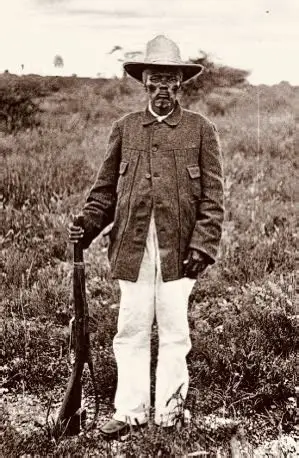
Hendrik Witbooi (c. 1830–1905) was a Nama leader who resisted German colonial expansion in present-day Namibia during the late nineteenth and early twentieth centuries. As chief of the ǀKhowesin Nama, he defended his people’s political independence and territorial rights against growing European interference.
Witbooi became one of the most prominent African leaders to challenge German imperial rule in southern Africa. His resistance involved military campaigns, political negotiations and appeals to other African leaders. His letters and diary also preserved his understanding of sovereignty, leadership and the struggle to protect his community.
His life reflects the wider history of African resistance to European colonial expansion and the violent consequences of Germany’s occupation of South West Africa.
Early Life and Family Background
Hendrik Witbooi was born around 1830 at Pella, south of the Orange River, in what is now South Africa’s Northern Cape. His family belonged to the ǀKhowesin, a Nama community with a long history of leadership in the region.
His grandfather, David Witbooi, led the community northwards across the Orange River into present-day Namibia. His father, Moses Witbooi, later became its chief. The family played an important role in the political organisation and movement of Nama communities during the nineteenth century.
Hendrik received a Christian education through Lutheran missionary institutions. He learned to read and write and became fluent in several languages, including Nama and European languages. His literacy later became an important political asset because he could communicate directly with colonial officials and other African leaders through letters.
He also worked as a teacher for a period. His education exposed him to Christian ideas and European political practices, but it did not weaken his commitment to Nama independence. Instead, he used his literacy and religious understanding to explain his position on sovereignty and colonial interference.
Becoming Chief of the ǀKhowesin Nama
Witbooi’s rise to leadership followed years of tension within the Nama community. He disagreed with his father over leadership and the direction of the group. Their relationship became strained as Hendrik developed his own political ambitions and sought to unite Nama communities under his authority.
After Moses Witbooi was killed in 1888, Hendrik became chief of the ǀKhowesin. He worked to strengthen his authority and expand his influence among neighbouring communities.
German colonial expansion increasingly threatened the independence of African societies in the region. Germany formally established control over South West Africa in the 1880s, encouraging European settlement and asserting authority over land and political affairs.
Witbooi opposed the idea that European claims could automatically override African sovereignty. He believed his people had their own political authority and the right to determine their future.
His correspondence with German officials showed that he understood the diplomatic language of colonial power. He questioned their claims, defended Nama independence and encouraged other African leaders to resist agreements that could place their communities under foreign control.
Resistance to German Colonial Expansion
Witbooi’s first major armed confrontation with German forces developed during the early 1890s. German officials wanted to extend their authority over Nama territory and secure the cooperation of local leaders.
In 1893, German colonial forces attacked Witbooi’s settlement at Hornkranz. The assault caused severe loss of life and destruction. Witbooi and his followers continued resisting, using the difficult terrain and mobile tactics to challenge the better-equipped German forces.
The conflict ended in 1894 when German military pressure forced Witbooi to accept a treaty. Under the agreement, he acknowledged German authority and undertook military obligations to the colonial administration.
The arrangement did not mean that Witbooi had abandoned his concerns about Nama independence. He continued to maintain his community’s internal leadership while navigating the political pressure created by German military power.
For a period, his forces cooperated with the Germans, including during conflicts involving the Herero. This relationship was shaped by the political and military circumstances of the time rather than permanent loyalty to colonial rule.
The 1904 Nama Uprising
The outbreak of the Herero uprising against German rule in January 1904 created a new political crisis in South West Africa. German forces responded with extreme violence, including a campaign of extermination against the Herero population.
Witbooi initially honoured his treaty obligations and supported the Germans against the Herero. However, German military actions and the colonial government’s treatment of African communities deepened his opposition.
In October 1904, Witbooi withdrew his support for the German administration and joined the wider resistance. He led the Nama uprising against German colonial rule, bringing his forces into a new conflict with the imperial army.
The Nama resistance formed part of the wider war that became known as the Herero and Nama genocide. German forces used military campaigns, forced displacement and policies that caused mass death among African communities.
Witbooi’s forces relied on mobility, local knowledge and guerrilla tactics. They attacked German positions and sought to avoid direct confrontations with larger and better-equipped military units. His leadership helped sustain the resistance despite the severe imbalance in military resources.
The uprising also reflected the broader struggle for control of land and political authority. Witbooi did not simply oppose individual colonial officials. He challenged the system that sought to subordinate Nama communities to German rule.
Leadership, Faith and Political Correspondence
Witbooi’s historical importance rests not only on his military resistance but also on his political thought. He was a committed Christian who interpreted his leadership responsibilities through religious belief. He often referred to divine authority when explaining his duty to protect his people.
His letters to German officials and other African leaders reveal a leader who understood the importance of diplomacy, political legitimacy and communication. He challenged colonial claims to sovereignty and urged African communities to consider the consequences of agreements with European powers.
His diary and correspondence later became valuable historical records. They provide insight into Nama political life, the pressures created by colonial expansion and the reasoning behind his decisions.
Witbooi’s writings also demonstrate that African leaders were not simply reacting to European military actions. They developed political arguments, negotiated treaties and pursued strategies to defend their communities.
Death and Legacy
Hendrik Witbooi died on October 29, 1905, after being wounded during a confrontation with German forces near Vaalgras in present-day Namibia. His death weakened the Nama resistance, although fighting continued after his death.
The conflict eventually resulted in devastating losses for the Nama people. German colonial repression, military operations and forced confinement caused widespread suffering. The Nama and Herero genocide remains one of the darkest chapters in Namibia’s history.
Witbooi became an enduring symbol of resistance to colonial rule. Namibia recognises him as a national hero, and his image appears on the country’s banknotes. His writings also remain important historical documents because they preserve an African leader’s own account of colonial conflict and political independence.
His legacy extends beyond Namibia. He represents a wider generation of African leaders who challenged European expansion through armed resistance, diplomacy and political organisation. His life also reminds readers that colonial conquest involved the suppression of established African governments, communities and systems of authority.
Conclusion
Hendrik Witbooi was a Nama chief whose resistance to German colonial expansion made him one of the important figures in southern African history. Through military leadership, political negotiation and written correspondence, he defended his people’s independence and challenged foreign control. His death in 1905 did not end the historical significance of his struggle. Today, his life remains closely associated with Namibian identity, African sovereignty and resistance to colonial rule.
Frequently Asked Questions
Who was Hendrik Witbooi?
Hendrik Witbooi was a chief of the ǀKhowesin Nama people who led resistance against German colonial rule in present-day Namibia during the late nineteenth and early twentieth centuries.
What was Hendrik Witbooi known for?
He was known for defending Nama political independence, leading resistance against German forces and writing letters and diary entries that documented his political views and experiences.
Where was Hendrik Witbooi born?
He was born around 1830 at Pella, south of the Orange River, in what is now South Africa’s Northern Cape.
Why did Hendrik Witbooi fight the Germans?
He opposed German colonial expansion because it threatened Nama sovereignty, land and political independence. He led a renewed uprising against German rule in October 1904.
When did Hendrik Witbooi die?
He died on October 29, 1905, after being wounded during a confrontation with German forces near Vaalgras in present-day Namibia.