|
Getting your Trinity Audio player ready... |
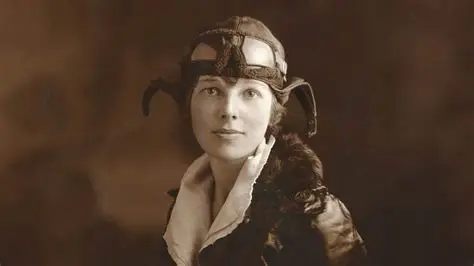
Amelia Earhart was an American aviator, author and pioneering figure in the history of aviation. She became the first woman to fly solo across the Atlantic Ocean and established several aviation records during a career that challenged contemporary expectations about women and flying.
Born in 1897 in Atchison, Kansas, Earhart developed an interest in aviation after experiencing her first airplane flight in 1920. She soon began flying lessons and eventually became one of the world’s most famous aviators.
Her career combined daring flights with advocacy for women’s opportunities in aviation and education. In 1937, while attempting to fly around the world, Earhart disappeared over the central Pacific Ocean. Despite decades of searches, the circumstances surrounding her disappearance remain unresolved.
Early Life and Family Background
Amelia Mary Earhart was born on July 24, 1897, in Atchison, Kansas. Her parents were Samuel “Edwin” Stanton Earhart, a lawyer, and Amelia Otis Earhart.
Earhart spent part of her childhood in Kansas and later lived in Des Moines, Iowa. She was described as adventurous from an early age and developed interests that were not always considered conventional for girls of her time.
Her family experienced financial difficulties during her youth. These challenges contributed to changes in where the family lived and affected her educational path.
Earhart eventually attended Ogontz School in Pennsylvania, although she did not complete a university degree.
Education and Early Career
During the First World War, Earhart volunteered as a nurse’s aide in Toronto, Canada, where she encountered wounded soldiers returning from the conflict.
After the war, she attended Columbia University in New York but left before completing her studies.
Her life changed after she took her first airplane ride in California in December 1920. The experience sparked a serious interest in aviation.
Earhart began taking flying lessons from instructor Anita “Neta” Snook and worked various jobs to pay for her training.
In 1921, she purchased her first aircraft, a secondhand Kinner Airster. She named it “The Canary.”
Rise to Aviation Fame
Earhart quickly developed a reputation as a determined pilot.
In October 1922, she set a women’s altitude record by reaching approximately 14,000 feet. Her achievements attracted attention during a period when aviation was still developing rapidly.
In 1928, publisher George Palmer Putnam asked Earhart to participate in a transatlantic flight.
Although she was a passenger rather than the pilot during that journey, the flight made her internationally famous. She later wrote about the experience and used the publicity to promote aviation.
Earhart understood the importance of public communication. She gave lectures, wrote books and articles, and became a highly recognizable advocate for aviation.
First Woman to Fly Solo Across the Atlantic
Earhart’s most famous aviation achievement came in 1932.
On May 20 and 21, she flew solo across the Atlantic Ocean from Newfoundland to Northern Ireland. The flight made her the first woman to accomplish the feat alone.
The journey was extremely challenging. Weather conditions were difficult, mechanical problems affected the aircraft and Earhart faced the constant risks associated with long-distance aviation.
Her achievement earned her international recognition and several honors.
She received the Distinguished Flying Cross from the United States Congress and became one of the world’s best-known aviators.
Other Aviation Records
Earhart continued setting aviation records after her transatlantic flight.
In 1932, she became the first woman to fly solo nonstop across the United States. She later completed the first solo flight by a woman from Hawaii to California.
She also established records for altitude and speed and participated in numerous long-distance flights.
Earhart did not treat these achievements simply as personal accomplishments. She used her public platform to encourage women to pursue careers traditionally dominated by men.
Amelia Earhart and Women’s Aviation
Earhart became an important advocate for women in aviation. She believed women should have opportunities to participate in professional and technical fields. She encouraged young women to develop independence and pursue careers based on their abilities rather than social expectations.
In 1929, she helped establish the Ninety-Nines, an international organization of women pilots. The group promoted fellowship, education and opportunities for female aviators. Earhart also worked as a lecturer and author. Her public image allowed her to reach audiences far beyond the aviation community. Her example helped challenge the belief that flying was primarily a male profession.
Marriage and Personal Life
Earhart married publisher George Palmer Putnam in 1931.
The marriage was unusual for its time because Earhart maintained a strong degree of professional independence. She continued flying, writing and lecturing rather than abandoning her career after marriage.
Earhart and Putnam worked closely on her aviation projects and public activities. Although she became one of the most famous women of her generation, Earhart generally attempted to keep the focus on her work and broader ideas about women’s independence.
Final Flight
In 1937, Earhart began an ambitious attempt to fly around the world. She was accompanied by navigator Fred Noonan. The pair travelled across several continents and completed most of the journey before reaching the central Pacific.
On June 1, 1937, Earhart and Noonan departed Miami for what would become the final stage of their journey. On July 2, they departed Lae, New Guinea, heading toward Howland Island. The aircraft was a Lockheed Electra 10E.
The planned flight was particularly demanding because Howland Island was extremely small and difficult to locate from the air. Earhart communicated by radio with the US Coast Guard cutter Itasca, which was positioned near Howland Island to assist with navigation. However, communication problems and navigation difficulties developed. Earhart’s aircraft was never seen again.
Disappearance of Amelia Earhart
Earhart and Noonan disappeared on July 2, 1937. The United States launched a major search operation, but no confirmed trace of the aircraft or its occupants was found. The official conclusion eventually became that the aircraft had probably run out of fuel and crashed into the Pacific Ocean.
However, numerous theories have emerged over the decades. Some researchers believe Earhart and Noonan may have landed on another island. Others have proposed that the aircraft crashed into the ocean near Howland Island.
Additional theories have suggested that the pair may have been involved in an intelligence mission, although such claims remain disputed and lack definitive evidence. Despite repeated searches, the exact circumstances of the disappearance remain uncertain.
Legacy and Historical Significance
Amelia Earhart’s legacy extends far beyond the mystery surrounding her final flight.
Her greatest historical contribution was helping establish aviation as a field in which women could achieve professional recognition. Her record-breaking flights demonstrated that women could undertake journeys that required exceptional technical skill, courage and endurance.
She also became an important symbol of independence. Earhart used her fame to encourage women to pursue education, careers and opportunities beyond traditional expectations.
Her disappearance added another dimension to her historical image. The unresolved mystery attracted generations of researchers, historians and aviation enthusiasts.
Books, documentaries, expeditions and scientific searches have continued to investigate what happened to her. Yet reducing Earhart’s legacy to her disappearance overlooks her actual achievements. Before her final flight, she had already established herself as a record-setting pilot, author, lecturer and advocate for women.
Her name remains associated with courage, exploration and aviation innovation. She also helped create a cultural image of the aviator as an adventurous figure willing to push beyond established boundaries. For that reason, Amelia Earhart remains one of the most recognizable pioneers in aviation history.
Read More: Odumegwu Ojukwu Biography: Early Life, Biafra Leadership, Civil War and Legacy
Frequently Asked Questions
Who was Amelia Earhart?
Amelia Earhart was an American aviator, author and aviation pioneer known for setting several records and promoting opportunities for women.
When was Amelia Earhart born?
She was born on July 24, 1897, in Atchison, Kansas.
What was Amelia Earhart famous for?
She was famous for becoming the first woman to fly solo across the Atlantic Ocean and for setting several other aviation records.
When did Amelia Earhart disappear?
Earhart disappeared on July 2, 1937, while attempting to fly from New Guinea to Howland Island.
Who was with Amelia Earhart during her final flight?
Navigator Fred Noonan accompanied Earhart during the final stages of her around-the-world flight.
Was Amelia Earhart ever found?
No confirmed remains of Earhart, Noonan or their aircraft have been recovered.
What is Amelia Earhart remembered for?
She is remembered as an aviation pioneer, record-setting pilot and advocate for women’s independence and participation in aviation.
Conclusion
Amelia Earhart transformed aviation history through her record-setting flights, public advocacy and determination to expand opportunities for women. Her solo Atlantic crossing established her as one of the leading aviators of her generation.
Although her disappearance remains unresolved, it is only one part of her historical story. Earhart’s achievements before 1937 had already established a lasting legacy of aviation innovation, courage and independence.
Her life continues to inspire interest because she did more than fly. She challenged the limits placed on women and demonstrated that determination and technical ability could open paths into fields once considered inaccessible.