|
Getting your Trinity Audio player ready... |
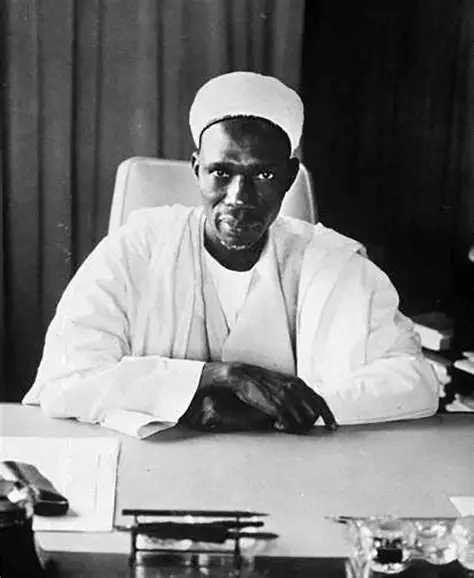
Sir Abubakar Tafawa Balewa was a Nigerian politician and statesman who became the country’s first Prime Minister. Born in 1912 in northern Nigeria, he moved from a career in education into politics and eventually became one of the principal leaders of Nigeria’s transition from British colonial rule to independence.
Balewa served as Prime Minister from 1957 until 1966 and led Nigeria when it gained independence on October 1, 1960. His leadership helped establish the country’s early parliamentary government and foreign policy.
His career unfolded during a difficult period of regional competition, constitutional negotiations and rising political tensions. His death during the military coup of January 1966 marked the end of Nigeria’s First Republic and became one of the defining events in the country’s early history.
Early Life and Family Background
Abubakar Tafawa Balewa was born in December 1912 in Tafawa Balewa, in present-day Bauchi State, Nigeria. His father, Yakubu Dan Zala, worked as an administrator for the district head of Lere.
Balewa grew up in northern Nigeria during British colonial rule. His background exposed him to traditional political institutions as well as the expanding colonial education system.
Unlike many members of Nigeria’s early political elite, Balewa began his professional life as an educator. His experience in education later influenced his interest in public service and political development.
Education and Teaching Career
Balewa received his early education in Bauchi before attending Bauchi Middle School. He later studied at Katsina Training College, where he trained as a teacher.
After completing his studies, he worked as a teacher and eventually became an inspector of education.
In 1945, Balewa travelled to Britain to study at the Institute of Education at the University of London. His experience abroad exposed him to wider political and educational ideas at a time when nationalist movements were gaining strength across Africa.
After returning to Nigeria, he continued working in education before becoming increasingly involved in politics.
Entry Into Politics
Balewa entered politics during a period when Nigerians were demanding greater representation in government.
In 1946, he became a member of the Northern House of Assembly. He later entered the Nigerian Legislative Council in Lagos, where he participated in debates about the country’s constitutional future.
Balewa became associated with the Northern People’s Congress, or NPC, one of the major political organizations in northern Nigeria.
His political approach initially favored gradual constitutional development rather than immediate independence. However, as Nigerian nationalism expanded, he became an important advocate of self-government.
His career developed alongside that of Sir Ahmadu Bello, the Sardauna of Sokoto, who remained the dominant political figure in northern Nigeria. Balewa increasingly became the region’s leading representative at the federal level.
Rise to National Leadership
Balewa served as Minister of Works and later Minister of Transport. These positions gave him experience in national administration and infrastructure.
Nigeria’s constitutional negotiations accelerated during the 1950s. Political leaders debated federalism, regional autonomy and the distribution of power in an independent Nigeria.
In 1957, Balewa became Prime Minister of the federal government, making him the first Nigerian to hold the position.
He then helped guide the country through the final stages of constitutional negotiations with Britain.
Prime Minister of Nigeria
As Prime Minister, Balewa faced the difficult task of governing a country divided into powerful regions with different political interests.
His government operated within a parliamentary system and depended on cooperation between political parties. Balewa generally adopted a cautious and diplomatic approach to national politics.
He worked to maintain Nigeria’s federal structure while managing competition among the major political parties and regions.
His administration also confronted problems involving economic development, regional rivalry and political representation. These challenges became increasingly serious as independence approached and Nigeria’s political institutions matured.
Nigeria’s Independence
Nigeria gained independence from Britain on October 1, 1960, with Balewa serving as Prime Minister.
His independence speech emphasized Nigeria’s sovereignty while maintaining friendly relations with Britain and other countries. Under his government, Nigeria began developing its identity as an independent African state.
Balewa’s administration inherited institutions created during colonial rule but faced the challenge of adapting them to national needs.
In 1963, Nigeria became a republic. Nnamdi Azikiwe became the country’s first President, while Balewa continued serving as Prime Minister.
The partnership between the two leaders became an important feature of Nigeria’s early republican government.
Foreign Policy and African Diplomacy
Balewa played an important role in establishing Nigeria’s early foreign policy.
His government supported African independence movements and opposed colonialism and racial discrimination. Nigeria also maintained diplomatic relations with Britain and other international powers.
Balewa supported African cooperation and promoted respect for national sovereignty. His government helped establish Nigeria as an important voice in African affairs.
These early principles influenced the country’s foreign policy for many years and contributed to Nigeria’s emergence as a major African diplomatic power.
Political Challenges and First Republic
Balewa’s government faced growing political instability during the 1960s.
Regional rivalry became increasingly intense, while disagreements over elections and political representation weakened cooperation among the country’s major parties.
The Western Region crisis of 1962 and the controversial federal election of 1964 contributed to political tensions. Further unrest followed the 1965 Western Region election.
These problems created widespread dissatisfaction with the First Republic. Allegations of electoral manipulation, political violence and corruption further weakened confidence in the civilian government.
On January 15, 1966, military officers launched Nigeria’s first coup.
Balewa was abducted during the coup and later killed. His death ended his political career and contributed to the collapse of Nigeria’s First Republic.
Death
Sir Abubakar Tafawa Balewa was killed in January 1966 during the military coup.
He was 53 years old.
His death occurred alongside the killing of several other senior political figures and military officers. The coup introduced military rule and fundamentally changed Nigeria’s political development.
The instability that followed eventually contributed to deeper national tensions and the Nigerian Civil War.
Legacy and Historical Significance
Tafawa Balewa remains one of the most important figures in Nigeria’s independence history.
His greatest distinction is that he became Nigeria’s first Prime Minister and led the federal government when the country gained independence in 1960.
He also helped establish Nigeria’s early diplomatic identity and supported African independence and cooperation.
His legacy, however, is complex. The First Republic struggled with regional competition, electoral disputes and institutional weaknesses. These challenges eventually contributed to the military intervention that ended civilian government.
Balewa’s career must therefore be understood within the wider difficulties of postcolonial nation-building. Nigeria inherited a politically divided colonial federation and attempted to create a unified national identity among many ethnic, cultural and regional communities.
Despite the controversies surrounding the First Republic, Balewa remains a symbol of Nigeria’s independence generation. His life represents both the optimism surrounding independence and the political difficulties that followed it.
His name has been preserved through public institutions, monuments and places associated with his life. His birthplace in Bauchi State also remains part of Nigeria’s historical memory.
For historians, Balewa’s importance lies not simply in being Nigeria’s first Prime Minister. His career provides insight into the political negotiations, constitutional development and diplomatic challenges that shaped the country’s earliest years as an independent state.
Read More: Amelia Earhart Biography: Early Life, Aviation Career, Records, Disappearance and Legacy
Frequently Asked Questions
Who was Sir Abubakar Tafawa Balewa?
Sir Abubakar Tafawa Balewa was a Nigerian statesman and the country’s first Prime Minister.
When was Tafawa Balewa born?
He was born in December 1912 in Tafawa Balewa, present-day Bauchi State, Nigeria.
What was Tafawa Balewa famous for?
He was famous for serving as Nigeria’s first Prime Minister and leading the country at independence.
When did Nigeria gain independence?
Nigeria gained independence from Britain on October 1, 1960, while Balewa was Prime Minister.
Who became Nigeria’s first President?
Nnamdi Azikiwe became Nigeria’s first President when the country became a republic in 1963.
How did Tafawa Balewa die?
He was abducted and killed during Nigeria’s first military coup in January 1966.
Why is Tafawa Balewa historically important?
He played a central role in Nigeria’s transition from colonial rule to independence and helped establish the country’s early parliamentary government and foreign policy.
Conclusion
Sir Abubakar Tafawa Balewa was a foundational figure in modern Nigerian history. From his beginnings as a teacher to his rise as the country’s first Prime Minister, he helped guide Nigeria through the final stages of colonial rule and independence.
His government faced serious regional and political challenges, and his death during the 1966 coup marked a dramatic turning point. Nevertheless, his contribution to Nigeria’s independence, early constitutional government and African diplomacy remains an important part of the country’s historical legacy.