|
Getting your Trinity Audio player ready... |
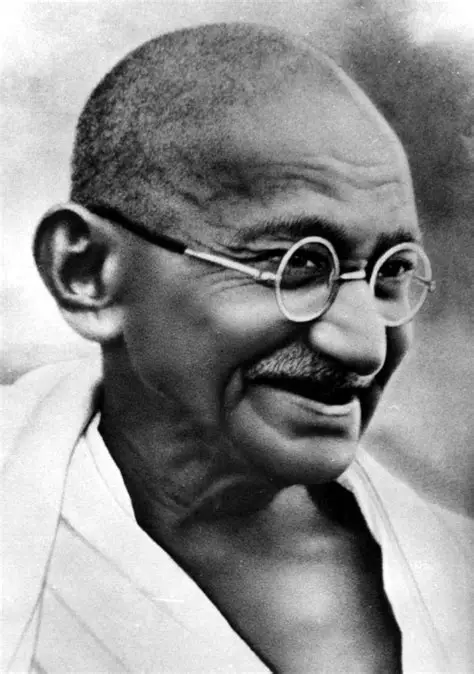
Mahatma Gandhi was an Indian lawyer, political leader and advocate of nonviolent resistance whose ideas transformed the struggle against British rule. Born Mohandas Karamchand Gandhi on October 2, 1869, he became one of the most influential figures in India’s independence movement.
Gandhi developed the philosophy of satyagraha, which emphasized truth, moral resistance and nonviolent action against injustice. He first developed the method during his years in South Africa before adapting it to India’s struggle for self-rule.
After returning to India in 1915, Gandhi became a central figure in the Indian National Congress. He led campaigns against colonial laws, promoted economic self-reliance and encouraged mass participation in the independence movement.
His political career also contained difficult contradictions. He opposed caste discrimination and defended the rights of marginalized communities, yet his views and methods have remained subjects of historical debate. His approach to race, caste, religion and political compromise has therefore received extensive scholarly examination.
Gandhi did not live to see India fully settle the consequences of independence. He was assassinated in New Delhi on January 30, 1948, less than six months after India became independent.
Early Life and Family Background
Mohandas Karamchand Gandhi was born in Porbandar, a coastal town in present-day Gujarat, India. His father, Karamchand Gandhi, served as the dewan, or chief minister, of Porbandar. His mother, Putlibai, was deeply religious and influenced the family’s spiritual environment.
Gandhi grew up in a Vaishnava Hindu household. Jain ideas about self-discipline and nonviolence also influenced the religious culture around him.
His childhood was relatively conventional for a boy from his social background. He attended school in Rajkot, where his father later served as a government official.
Gandhi’s early religious environment became important to his later thinking. Ideas about self-restraint, fasting, compassion and moral duty became central to the philosophy he developed as an adult.
The Gandhi family later became part of a much larger historical legacy. His four sons with Kasturba Gandhi were Harilal, Manilal, Ramdas and Devdas.
Education and Formative Years
Gandhi attended schools in Porbandar and Rajkot before completing his secondary education. He was not regarded as an exceptional student during his early school years.
In 1888, at the age of 18, he travelled to England to study law. He enrolled at the Inner Temple in London and began preparing for a legal career.
Life in London exposed Gandhi to a different culture. He initially tried to adopt aspects of English dress and social life, but gradually developed a stronger interest in religion and personal discipline.
He studied religious texts and became interested in Christianity, Hindu philosophy and other traditions. These encounters expanded his understanding of religion beyond the environment of his childhood.
Gandhi was called to the Bar in 1891. He returned to India that year and attempted to establish a legal practice.
Marriage and Family
Gandhi married Kasturbai Makhanji, commonly known as Kasturba Gandhi, in 1882. Both were teenagers at the time.
Their marriage lasted until Kasturba’s death in 1944. The couple had four surviving sons: Harilal, Manilal, Ramdas and Devdas. The Gandhi Heritage Portal records the family relationships and descendants of Gandhi and Kasturba.
Their relationship changed considerably as Gandhi’s religious and political ideas developed. His increasingly strict approach to personal discipline affected family life.
Kasturba nevertheless became an important participant in his public work. She joined campaigns and endured imprisonment during the independence struggle.
The family also became part of Gandhi’s experiments with communal living, simplicity and self-discipline.
Education in London and Legal Career
After returning to India, Gandhi struggled to establish himself as a lawyer in Bombay. His limited courtroom experience made the beginning of his legal career difficult.
A professional opportunity changed his direction. In 1893, an Indian business firm offered him a legal assignment in South Africa.
Gandhi travelled to Natal and initially expected to remain there for only a short period. Instead, he spent roughly two decades in South Africa.
The experience changed his life.
He encountered racial discrimination directed at Indians living under the colonial system. One famous incident occurred when he was removed from a first-class railway compartment at Pietermaritzburg despite holding a valid ticket.
These experiences pushed him toward political activism. They also forced him to reconsider the role of law when legal systems themselves supported discrimination.
Gandhi in South Africa
Gandhi gradually became a leader among the Indian community in South Africa.
In 1894, he helped establish the Natal Indian Congress. The organization sought to defend the political and legal interests of Indians in Natal.
He also founded and supported newspapers and communal settlements. Indian Opinion, launched in 1903, became an important vehicle for discussing political and social issues affecting Indians.
During this period, Gandhi experimented with communal living at the Phoenix Settlement and later at Tolstoy Farm.
His political methods also developed. Rather than relying only on petitions or legal arguments, he began encouraging organized nonviolent resistance.
The South African campaigns laid the foundation for satyagraha. Gandhi described the method as a form of resistance based on truth and moral courage rather than physical force.
The approach became more clearly defined during the campaigns against discriminatory registration laws in the Transvaal. The Gandhi Heritage Portal records September 11, 1906, as a key date in the emergence of satyagraha.
Development of Satyagraha
Satyagraha became the central political method associated with Gandhi.
The philosophy differed from passive surrender. Gandhi believed that people could resist unjust laws while refusing to respond with violence.
This approach demanded discipline from protesters. Participants were expected to accept arrest and punishment rather than retaliate against authorities.
Gandhi also connected political resistance with personal conduct. He promoted simplicity, fasting, self-control and service as parts of his wider philosophy.
His South African experience gave him practical experience in organizing campaigns. When he returned to India in 1915, he brought these methods into a much larger political environment.
Return to India and Rise as a National Leader
Gandhi returned to India in January 1915 after spending years in South Africa.
He initially travelled extensively through the country and studied local conditions. His political mentor, Gopal Krishna Gokhale, encouraged him to understand India before entering national politics.
Gandhi soon became involved in local struggles involving peasants and workers. His campaigns in Champaran, Kheda and Ahmedabad helped establish his reputation as a national political leader.
The First World War and its aftermath transformed Indian politics. Many Indians had expected political reforms in return for their support of the British war effort.
Instead, the colonial government introduced measures that Gandhi and other nationalists regarded as repressive. The Rowlatt Acts of 1919 allowed detention without the normal judicial protections.
The Jallianwala Bagh massacre in April 1919 further damaged Indian confidence in British rule. British troops under General Reginald Dyer fired on a large gathering in Amritsar, killing and wounding hundreds.
Gandhi increasingly moved toward nationwide resistance.
Non-Cooperation Movement
In 1920, Gandhi helped lead the Non-Cooperation Movement.
The campaign encouraged Indians to withdraw cooperation from British institutions. This included boycotts of foreign cloth, government schools and other colonial institutions.
Gandhi believed political freedom required mass participation. He therefore encouraged ordinary Indians to take part rather than leaving independence politics to lawyers and educated elites.
The movement became one of the first major nationwide campaigns against British rule.
However, Gandhi suspended it in 1922 after violence broke out at Chauri Chaura, where protesters killed police officers.
His decision disappointed some nationalists. Gandhi nevertheless believed that a movement committed to nonviolence could not continue after participants had embraced deadly violence.
British authorities arrested him in March 1922. He was convicted of sedition and sentenced to six years in prison, although he was released in 1924 after undergoing an operation.
Salt March and Civil Disobedience
Gandhi returned to mass political action in 1930 with the Salt Satyagraha.
The British government maintained laws controlling the production and sale of salt. Gandhi recognized that salt could unite Indians across social and economic divisions because everyone needed it.
On March 12, 1930, he left Sabarmati Ashram with 78 followers and began a march toward Dandi on the Arabian Sea coast. The journey covered roughly 240 miles.
On April 6, Gandhi broke the salt laws by making salt from seawater.
The action became a symbol of resistance to colonial authority. Thousands followed his example, and civil disobedience spread across India.
British authorities arrested tens of thousands of protesters. Gandhi was arrested in May.
The Salt March did not immediately end British rule. Its importance came from its ability to mobilize large numbers of Indians and attract international attention to the independence struggle.
Quit India Movement
The Second World War created another major confrontation between Indian nationalists and Britain.
In 1942, the Indian National Congress launched the Quit India Movement. Gandhi called for an end to British rule and demanded immediate independence.
British authorities responded by arresting Gandhi and other Congress leaders.
The movement faced severe repression. Demonstrations spread despite the imprisonment of national leaders.
Gandhi remained committed to nonviolence, although parts of the movement became violent after the arrests.
The war eventually weakened Britain’s ability to maintain its empire. Political negotiations intensified after the conflict.
Gandhi and Indian Independence
India became independent on August 15, 1947.
Gandhi had played a major role in turning independence from a cause led largely by political elites into a mass movement. However, he did not achieve every political objective he had pursued.
The independence settlement included the partition of British India into India and Pakistan.
Gandhi opposed partition and was deeply distressed by the communal violence that accompanied it. Instead of joining independence celebrations in Delhi, he spent much of the period working to reduce violence.
His priority became reconciliation between Hindus and Muslims.
In Calcutta and later Delhi, he used fasting, prayer and personal appeals to encourage communities to stop attacking one another. His final months therefore focused less on political power and more on preventing communal bloodshed.
Gandhi’s Political and Social Ideas
Gandhi’s philosophy extended beyond independence from Britain.
He promoted swadeshi, encouraging Indians to use locally produced goods. He regarded the spinning wheel and khadi cloth as symbols of economic self-reliance.
He also campaigned against untouchability and worked to improve the social position of communities subjected to caste discrimination.
His approach to caste remains historically contested. Gandhi opposed untouchability, but his views on the caste system differed from those of other reformers, particularly B.R. Ambedkar.
Gandhi also promoted village-based economic life, simple living and decentralized political structures.
Religion remained central to his worldview. He drew from Hindu traditions while emphasizing tolerance and dialogue among faiths.
His political philosophy therefore combined nationalism with moral discipline, social reform and religious pluralism.
Later Years and Partition
The final phase of Gandhi’s life was dominated by communal conflict.
Partition produced enormous population movements and widespread violence. Millions of people crossed newly created borders between India and Pakistan.
Gandhi travelled to areas affected by violence. He visited Bengal and Bihar and later worked in Delhi.
In January 1948, he began a fast in Delhi to press for communal peace. He ended it after political and community leaders gave assurances that violence would stop.
The Gandhi Heritage Portal records January 12 as the beginning of this final fast and January 18 as the day he broke it.
Even after the fast ended, Gandhi remained a target for extremists who opposed his position on Hindu-Muslim relations.
Assassination and Death
On January 30, 1948, Gandhi left for his evening prayer meeting at Birla House in New Delhi.
Nathuram Godse approached him and shot him three times.
Gandhi died at the scene. The assassination shocked India and generated international mourning.
The Gandhi Heritage Portal records that Gandhi was killed while going to his evening prayer meeting. His body was cremated at Raj Ghat on January 31, 1948.
Gandhi was 78 years old.
His assassination ended a life that had moved from a relatively conventional legal career to international political leadership.
Legacy and Historical Significance
Gandhi’s historical importance rests primarily on his development and use of organized nonviolent resistance.
He demonstrated that civil disobedience could become a mass political strategy. The method helped mobilize people who had limited access to conventional political institutions.
His campaigns also changed how anti-colonial resistance was understood internationally. The Salt March became particularly important because a simple dispute over salt laws became a vehicle for challenging the authority of an empire.
Gandhi’s influence extended beyond India. Later civil rights and independence leaders studied his methods, including Martin Luther King Jr., whose campaigns in the United States drew on Gandhian ideas of nonviolent resistance.
His legacy is not without debate. Historians and scholars have examined his positions on caste, race, women, industrialization and political compromise. His record must therefore be understood in its full historical setting rather than reduced to an image of perfect moral consistency.
Even with these debates, Gandhi remains one of the most consequential figures in the history of anti-colonial politics. His ideas about nonviolence, civil resistance and moral responsibility continue to shape political thought and movements around the world.
Read More: Locksley Edmondson Biography: Early Life, Education, Academic Career, Books and Legacy
Conclusion
Mahatma Gandhi’s life was shaped by the political and social changes of the late 19th and early 20th centuries. His experiences in South Africa transformed him from a lawyer into an activist, while his return to India placed him at the centre of the struggle against British colonial rule.
Through satyagraha, mass civil disobedience and campaigns such as the Salt March, Gandhi helped create a new model of political resistance. His efforts also extended into social reform, religious reconciliation and economic self-reliance.
Gandhi’s legacy remains complex. His achievements in nonviolent resistance coexist with continuing debates about some of his social and political views. Yet his influence on anti-colonial politics and civil resistance makes him an enduring figure in modern world history.