|
Getting your Trinity Audio player ready... |
Barry Melrose was a Canadian ice hockey player, coach and broadcaster who became one of the most recognizable voices in hockey. Born in Kelvington, Saskatchewan, in 1956, he first made his name as a rugged defenseman before moving into coaching.
His coaching career reached its highest point when he guided the Los Angeles Kings to the 1993 Stanley Cup Final with Wayne Gretzky as captain. He later became even more widely known through his long career as an ESPN hockey analyst.
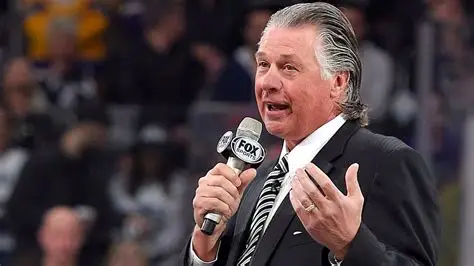
Melrose joined ESPN in the 1990s and became a defining personality in American hockey coverage. His mullet, goatee, colorful suits and direct style made him easy to recognize, while his knowledge of the game earned respect from players, coaches and fans.
In 2023, Melrose retired from broadcasting after receiving a Parkinson’s disease diagnosis. He died in 2026 at the age of 70, leaving behind a career that connected professional hockey, coaching and sports broadcasting.
Early Life and Family Background
Barry James Melrose was born on July 15, 1956, in Kelvington, Saskatchewan, Canada.
He grew up in a rural Saskatchewan community where hockey played an important role in local life. His early years on the family farm helped shape the tough and practical personality that later became part of his public image.
Hockey also ran through Melrose’s extended family. He was a first cousin of former NHL player Wendel Clark, while hockey sources also identify former NHL player Joe Kocur as a distant cousin.
Melrose developed a strong interest in both hockey and baseball while growing up. His athletic ability eventually led him into junior hockey and toward a professional career.
Kelvington remained important to him throughout his life. Even after achieving fame in the NHL and on television, he maintained strong connections with Saskatchewan and continued playing fast-pitch softball during the offseason.
Education and Early Hockey Career
Melrose developed as a defenseman through junior hockey in Western Canada. He played for the Kamloops Chiefs in the Western Canada Hockey League during the mid-1970s.
His physical style suited the demands of defense. He was not known primarily as a scoring star, but he became valued for toughness, defensive play and his willingness to compete in difficult situations.
In the 1976 NHL Draft, the Montreal Canadiens selected Melrose in the second round with the 36th overall pick. Instead of immediately joining Montreal, he began his professional career in the World Hockey Association.
He played for the Cincinnati Stingers, where he spent three seasons from 1976 to 1979. The WHA period also gave him an opportunity to play alongside future hockey legends, including a young Mark Messier.
Professional Playing Career
The collapse of the World Hockey Association in 1979 opened the way for Melrose to enter the NHL. He joined the Winnipeg Jets and made his NHL debut on October 10, 1979.
Melrose later played for the Toronto Maple Leafs and Detroit Red Wings. His NHL career lasted from 1979 to 1986, with additional time spent in the minor leagues.
He finished with 300 NHL regular-season games, recording 10 goals and 23 assists. He also accumulated 728 penalty minutes, reflecting the physical nature of his playing style.
Melrose played seven NHL playoff games with Toronto and recorded two assists. His professional career also included 178 WHA games, where he scored five goals and recorded 32 points.
He ended his playing career in the mid-1980s. Rather than leaving hockey, however, he quickly moved toward coaching, beginning another phase of his career.
Coaching Career
Melrose began coaching in 1987 with the Medicine Hat Tigers of the Western Hockey League.
His first coaching opportunity produced an immediate success. He guided Medicine Hat to the Memorial Cup championship, establishing himself as a promising young coach.
He later coached the Seattle Thunderbirds before taking charge of the Adirondack Red Wings of the American Hockey League. His time in Adirondack became another major achievement.
In the 1991-92 season, Melrose led the Red Wings to the Calder Cup championship. He also served as the team’s general manager during part of his tenure.
His success in the minor leagues eventually brought him to the NHL. In 1992, the Los Angeles Kings hired him as their head coach.
Los Angeles Kings and the 1993 Stanley Cup Final
Melrose took charge of the Los Angeles Kings for the 1992-93 season. The team featured Wayne Gretzky, one of the greatest players in hockey history, along with future stars and important veterans.
The Kings quickly became one of the NHL’s most compelling teams. They defeated the Calgary Flames, Vancouver Canucks and Toronto Maple Leafs during the playoffs.
Los Angeles reached the 1993 Stanley Cup Final, the first Stanley Cup Final appearance in franchise history. The Kings faced the Montreal Canadiens but lost the series in five games.
The playoff run became the defining achievement of Melrose’s coaching career. He had taken an NHL team to the championship series in his first season as an NHL head coach.
Melrose remained with the Kings for two more seasons. The team did not return to the playoffs during those campaigns, and he was dismissed during the 1994-95 season.
His overall regular-season record with Los Angeles was 79-101-29, while he went 13-11 in the playoffs.
ESPN Broadcasting Career
Melrose moved into broadcasting after his coaching career in Los Angeles. He had already worked as a hockey analyst during playoff coverage before becoming a regular ESPN personality.
He joined ESPN as a full-time hockey analyst in 1996. The move transformed his public profile.
Melrose had the ability to explain hockey in a way that worked for both experienced fans and casual viewers. He spoke directly, showed strong opinions and often mixed analysis with humor.
His appearance became part of his television identity. His long hair, goatee and distinctive suits made him instantly recognizable whenever he appeared on screen.
Over the years, he worked alongside broadcasters including Steve Levy and John Buccigross. He covered regular-season games, All-Star events and the Stanley Cup Playoffs, including the Stanley Cup Final.
His television career lasted far longer than his time behind an NHL bench. ESPN ultimately became the platform through which millions of American viewers came to know Melrose.
Return to Coaching with Tampa Bay
Melrose did not completely abandon coaching after joining ESPN.
In 2008, he returned to the NHL when the Tampa Bay Lightning hired him as head coach. The move attracted considerable attention because he had been away from coaching for more than a decade.
His return lasted only 16 games. Tampa Bay started the 2008-09 season with a 5-7-4 record, and the team dismissed him in November 2008.
Melrose then returned to ESPN. The experience reinforced the direction his career had taken. Although coaching had produced some of his most important sporting achievements, broadcasting had become his most enduring professional role.
His overall NHL coaching record, including his time with Tampa Bay, was 84-108-29-4.
Later ESPN Career and Parkinson’s Diagnosis
After returning to ESPN in 2009, Melrose remained a prominent figure in the network’s hockey coverage.
His appeal went beyond statistical analysis. He brought the perspective of a former player and coach while retaining the informal style that had made him popular with viewers.
Melrose’s broadcasting career eventually lasted about 27 years. By the time he left ESPN, he had become one of the network’s longest-serving and most recognizable hockey personalities.
In 2023, Melrose announced that he had been diagnosed with Parkinson’s disease and was retiring from ESPN. He said he wanted to focus on his health and family after more than five decades in hockey.
His retirement marked the end of a major era in ESPN’s hockey coverage. Former colleagues and hockey figures publicly recognized his contribution to the sport and his distinctive broadcasting personality.
Personal Life and Family
Melrose was married to Cindy Melrose, who remained his wife until his death. They had two sons, Tyrell and Adrien.
Despite his national profile, Melrose maintained strong ties to his Saskatchewan roots. His connection to Kelvington remained part of his identity throughout his professional life.
He also enjoyed baseball and fast-pitch softball. During the offseason, he played alongside other Saskatchewan hockey figures, including Wendel Clark and other former NHL players.
These activities reflected another side of Melrose’s personality. Away from the television studio and NHL bench, he remained closely connected to the sporting culture of the community where he grew up.
Death
Barry Melrose died on September 9, 2026, at the age of 70. His wife, Cindy, informed ESPN of his death.
His death came three years after his Parkinson’s disease diagnosis and retirement from ESPN. Public reports following his death did not establish a separate specific cause beyond his illness, so claims about a more precise medical cause should be treated cautiously.
Tributes followed from across the hockey world. The NHL, ESPN, former colleagues and major figures connected to the sport remembered Melrose for his enthusiasm, knowledge and unusual ability to make hockey accessible.
Wayne Gretzky, whom Melrose coached with the Los Angeles Kings, had previously described him as someone who had become larger than any individual team.
Legacy and Historical Significance
Barry Melrose’s legacy rests on three distinct careers that were closely connected by hockey.
As a player, he represented the tough defensive style associated with professional hockey in the 1970s and 1980s. His playing statistics were modest, but his experience across the WHA, NHL and minor leagues gave him a broad understanding of the sport.
As a coach, his greatest achievement came with the Los Angeles Kings. Taking the team to its first Stanley Cup Final in 1993 remains the most important competitive milestone of his coaching career.
His greatest public influence, however, came through broadcasting. For nearly three decades, Melrose helped bring NHL analysis to American television audiences through ESPN.
His style mattered because he did not present hockey as an inaccessible technical exercise. He combined knowledge with personality, humor and strong opinions. That approach helped him connect with viewers who wanted both analysis and entertainment.
His appearance also became part of hockey culture. The mullet, goatee and colorful suits were instantly associated with his television persona, but those features never replaced his understanding of the game.
Melrose also represented a rare career path in professional sport. He moved successfully from player to coach and then from coach to broadcaster, with each stage informing the next.
His long ESPN career ultimately became his most enduring contribution to hockey culture. He helped define how the sport was discussed on American television during a period when the NHL expanded its national profile.
Melrose was never simply remembered as the coach who took Gretzky and the Kings to a Stanley Cup Final. He became a familiar presence for generations of hockey viewers.
His legacy therefore extends beyond wins and losses. It lies in the connection he created between the game, the people who played it and the audiences who watched it.
Read More: Cyprian Ekwensi Biography: Early Life, Career and Legacy
Conclusion
Barry Melrose built an unusual career across three sides of professional hockey.
He played in the WHA and NHL, coached the Los Angeles Kings to their first Stanley Cup Final and later became one of ESPN’s most recognizable hockey analysts.
His greatest influence came through television, where his knowledge and personality made him a familiar figure to generations of fans.
Melrose’s death in 2026 ended a career that spanned more than five decades. His place in hockey history comes not from one championship, but from the lasting connection he created between the sport and its audience.