|
Getting your Trinity Audio player ready... |
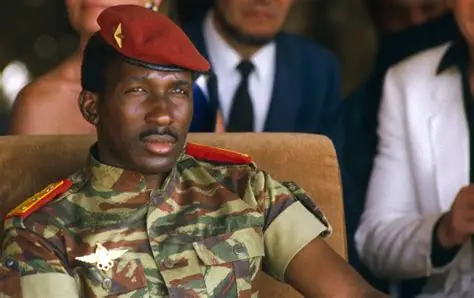
Thomas Sankara was a Burkinabé military officer, revolutionary leader and Pan-Africanist who became president of Burkina Faso in 1983. During four years in power, he pursued major political, economic, social and environmental reforms while challenging foreign dependency and official privilege. His government expanded vaccination and literacy campaigns, promoted women’s participation, invested in rural services and changed the country’s name from Upper Volta to Burkina Faso.
Sankara’s presidency also had a coercive side. His revolutionary government restricted conventional political opposition and relied on mass organizations to mobilize society. Economic policies placed strong controls on private activity, while political opponents faced repression. His assassination in a 1987 coup ended his government and became one of the defining events in Burkina Faso’s modern history.
Early Life and Family Background
Thomas Isidore Noël Sankara was born on December 21, 1949, in Yako, then part of French Upper Volta. He was the third of ten children of Joseph and Marguerite Sankara. His father served in the colonial security service, and the family lived in different parts of the country because of his work. Sankara grew up in a Catholic household and initially faced expectations that he might enter the priesthood.
His childhood unfolded during the final decades of French colonial rule. Upper Volta was a poor, landlocked territory with limited infrastructure and a predominantly rural population. These conditions later influenced Sankara’s emphasis on self-reliance, rural development and reducing dependence on foreign assistance.
Education and Military Career
Sankara attended Catholic schools before choosing military training instead of a religious career. He received further military education in Madagascar, where he encountered revolutionary political ideas and witnessed the Malagasy upheaval of 1972. The experience contributed to his developing interest in Marxism, African independence and social transformation.
He also developed a reputation as a disciplined young officer. In 1974, he fought in a border conflict between Upper Volta and Mali. Although he remained a soldier, his political awareness increasingly separated him from officers who viewed military service simply as a career.
Entry into Politics
Sankara entered government as Secretary of State for Information in 1981 and became Prime Minister in January 1983 under President Jean-Baptiste Ouédraogo. His outspoken criticism of corruption and his alliances with left-wing officers made him increasingly difficult for the government to contain. He was dismissed and placed under house arrest in May 1983.
On August 4, 1983, soldiers and political allies seized power. Sankara became president at the age of 33 and established the National Council of the Revolution. His government presented the revolution as an effort to reorganize political and economic life around national independence, social equality and popular participation.
Presidency and the Burkinabé Revolution
One of Sankara’s earliest symbolic decisions was to rename Upper Volta Burkina Faso in August 1984. The name combines words from different national languages and is commonly translated as “Land of Incorruptible People.” The change reflected his attempt to promote a postcolonial national identity.
His government also sought to reduce official extravagance. Ministers and senior officials faced restrictions on luxury and government spending, while the administration emphasized public service and personal austerity. Sankara became associated with a modest lifestyle that contrasted with the privileges often attached to political office.
The revolution established Committees for the Defense of the Revolution, known as CDRs, to mobilize citizens and support government programs. They also became instruments of political control. This dual role is important to understanding Sankara’s government because it encouraged mass participation while limiting conventional political pluralism.
Major Achievements and Reforms
Sankara’s government placed health and education among its major priorities. A large vaccination campaign sought to increase childhood immunization, while new health posts were constructed in rural areas. A World Bank historical assessment recorded a rapid increase in vaccination rates and a sixfold rise in village health posts during the period. Hundreds of rural schools were also built.
The administration promoted literacy campaigns and attempted to expand access to land and basic services. It pursued food self-sufficiency and encouraged local production as part of a broader strategy to reduce economic dependence. The government also imposed austerity measures and sought to increase domestic revenue.
Environmental protection became another part of the program. Sankara’s government promoted tree planting, anti-desertification measures and changes in farming practices. These policies reflected the pressures facing a Sahelian country where drought, soil degradation and food insecurity posed serious development challenges.
The economic record was more complicated. The World Bank later described the period as one of strong state intervention and ambitious social objectives, but also concluded that several policies were economically unsustainable. Public investment and agricultural production supported growth in some years, yet fiscal pressures and controls over private activity contributed to later difficulties.
Women, Environment and Pan-Africanism
Sankara placed unusual emphasis on women’s participation in public life. His government appointed women to political and administrative positions and opposed practices including forced marriage and female genital mutilation. Women were encouraged to participate in revolutionary organizations and national institutions.
He also linked women’s emancipation to national development. His government organized public initiatives that highlighted the unequal distribution of domestic labor and encouraged men to share household responsibilities. Gender equality therefore became a visible part of the revolutionary program.
Internationally, Sankara advocated African unity and greater economic independence. He criticized colonial legacies, foreign intervention and the growing burden of African debt. His speeches at African and international forums gave Burkina Faso a prominent voice despite its limited economic power. His government sought relationships based on greater equality rather than dependence on former colonial powers.
Assassination and Death
Thomas Sankara was assassinated in Ouagadougou on October 15, 1987, during a coup. Blaise Compaoré took power afterward. Sankara was 37 years old. The United Nations Human Rights Committee later documented the failure of Burkina Faso to conduct an effective investigation into the assassination and found violations concerning the rights of his family.
The circumstances of his death remained politically sensitive for decades. In 2014, authorities authorized the exhumation of Sankara’s presumed remains. Later investigations led to charges against several individuals in connection with the assassination, while former president Blaise Compaoré was also named in proceedings concerning the case.
Legacy and Historical Significance
Thomas Sankara’s historical significance rests on the combination of political revolution, social programs, Pan-Africanism and his challenge to established patterns of power. His government lasted only four years, yet its campaigns in health, education, women’s participation and environmental protection left a documented mark on Burkina Faso.
His legacy also requires historical balance. Sankara governed through a revolutionary military system rather than a conventional multiparty democracy. The CDRs could mobilize citizens, but they also reinforced political control. Economic intervention produced ambitious public programs but created pressures that later governments sought to reverse.
Sankara remains an important subject in African political history because his government placed national self-reliance, social development and African sovereignty at the center of public debate. His speeches and writings continue to provide material for scholars examining African nationalism, development and postcolonial state-building.
Frequently Asked Questions
Who was Thomas Sankara?
Thomas Sankara was a Burkinabé military officer, revolutionary leader and Pan-Africanist who served as president of Burkina Faso from 1983 until his assassination in 1987.
What was Thomas Sankara known for?
He was known for reforms involving health, education, agriculture, women’s participation, environmental protection and economic self-reliance.
Why did Thomas Sankara rename Upper Volta?
His government renamed Upper Volta Burkina Faso in 1984 as part of an effort to establish a postcolonial national identity.
How did Thomas Sankara die?
Sankara was assassinated during a coup in Ouagadougou on October 15, 1987.
How old was Thomas Sankara when he died?
Thomas Sankara was 37 years old when he was assassinated.
Conclusion
Thomas Sankara’s four years in power created one of the most closely studied revolutionary periods in modern African history. His government combined ambitious social programs with strict political control and state-directed economic policies. His assassination in 1987 ended the revolution he had led, but the questions he raised about African sovereignty, public accountability, women’s rights and development continued long after his death.