|
Getting your Trinity Audio player ready... |
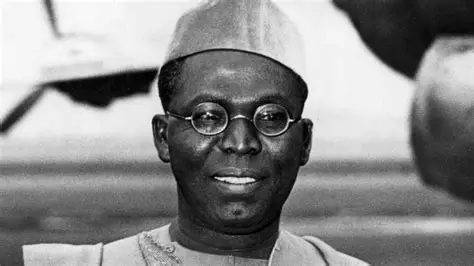
Obafemi Jeremiah Oyeniyi Awolowo (1909–1987) was a Nigerian statesman, nationalist, lawyer and political thinker who played a major role in Nigeria’s independence movement. He became the first Premier of the Western Region and later served as a federal minister during the Nigerian Civil War. His political career was closely associated with education, federalism, regional development and organized political action.
Awolowo also founded the Action Group and the Nigerian Tribune. His government in the Western Region introduced a major free primary education programme, while his later political writings developed ideas about federalism, economic planning and social welfare. His career also included imprisonment, unsuccessful presidential campaigns and major debates over Nigeria’s political direction.
Early Life and Family Background
Obafemi Awolowo was born on March 6, 1909, in Ikenne, in present-day Ogun State, Nigeria. His birth name was Jeremiah Obafemi Oyeniyi Awolowo. He grew up in a Yoruba community during British colonial rule, when education, commerce and nationalist politics were becoming increasingly important in Nigerian society.
His father died while Awolowo was still young. He therefore experienced financial pressures that shaped his early working life. Before becoming a lawyer and politician, he worked at different times as a farmer, produce broker, teacher, typist, clerk and journalist.
These varied occupations gave him experience outside the colonial professional class. His early journalism also gave him an avenue for discussing political and social questions at a time when Nigerian nationalism was developing.
Education and Early Career
Awolowo attended Baptist Boys’ High School in Abeokuta before studying at Wesley College in Ibadan. He later worked as a teacher and clerk while developing his professional interests. His education was partly supported by his own work and commercial activities.
In 1927, he enrolled as an external student of the University of London and eventually obtained a Bachelor of Commerce degree. He continued working as a journalist and became involved in Nigerian nationalist circles.
Awolowo travelled to Britain in 1944 to study law. He entered the Inner Temple and was called to the English Bar in 1946. He returned to Nigeria in 1947 and established a legal practice in Ibadan.
His years in Britain also strengthened his political thinking. In 1945, he founded Egbe Omo Oduduwa, an organization that promoted Yoruba cultural unity. He later used the networks created through the organization as part of his wider political organizing.
Political Awakening and the Action Group
Awolowo became increasingly active in the nationalist movement after returning to Nigeria. In 1949, he founded the Nigerian Tribune, which became a platform for political discussion and nationalist ideas.
In 1951, he helped establish the Action Group. The party organized heavily across the Western Region and promoted political independence alongside programmes involving education, health, economic development and local government. The Action Group won control of the regional government after the 1951 elections.
Awolowo initially became Leader of Government Business and Minister for Local Government in 1952. In 1954, he became the first Premier of the Western Region. His government then embarked on an ambitious programme of social and economic development.
Premier of the Western Region
Education became one of the defining features of Awolowo’s administration. In January 1955, the Western Region introduced free primary education, accompanied by an expansion of teacher training and educational infrastructure. The programme became one of the most significant education initiatives in colonial Nigeria.
The policy was linked to Awolowo’s belief that mass education was necessary for economic development and political participation. The regional government also invested in agriculture, health services, technical education and economic planning. These policies formed part of a broader development strategy rather than an isolated education programme.
The Western Region also established Western Nigeria Television in 1959, an important development in broadcasting. Other projects associated with the period included industrial and agricultural initiatives and the development of major public infrastructure.
Awolowo’s administration became an important example in later Nigerian debates about the relationship between regional autonomy, public investment and social development. At the same time, the scale and cost of the programmes generated political and financial debates that continued beyond his premiership.
Independence and Federal Politics
Awolowo resigned as Premier in 1959 after being elected to the federal House of Representatives. He became Leader of the Opposition in the federal Parliament as Nigeria approached independence in 1960.
He advocated a federal political structure because he believed Nigeria’s different regions and communities required substantial autonomy within a united country. The 1954 constitutional arrangements had established a federal system involving the Northern, Eastern and Western Regions, and federalism became a central part of Awolowo’s political philosophy.
The Action Group struggled to extend its political influence across Nigeria. Awolowo’s relationship with other major nationalist leaders, including Nnamdi Azikiwe and Ahmadu Bello, reflected wider disagreements over federalism, regional power and the structure of the emerging Nigerian state.
In 1962, Awolowo was arrested and later convicted of conspiracy to overthrow the federal government. He received a ten-year prison sentence. He remained in prison during a significant part of the First Republic and was released after the military takeover of 1966.
Civil War and Later Political Career
During the Nigerian Civil War, Awolowo joined the federal government under General Yakubu Gowon. From 1967 to 1971, he served as Federal Commissioner for Finance and Vice Chairman of the Federal Executive Council.
The civil war placed Awolowo in a difficult political position. His earlier advocacy of federalism had to be considered alongside the government’s efforts to preserve Nigeria’s territorial unity. His wartime role remains an important part of discussions about the political and economic history of the conflict.
After the war, Awolowo remained active in national politics. He became a leading figure in the Unity Party of Nigeria during the Second Republic and contested the presidency in 1979 and 1983. His campaigns continued to emphasize education, social welfare, economic planning and federalism.
He also produced several political works, including Path to Freedom, Awo: The Autobiography of Chief Obafemi Awolowo and Thoughts on the Nigerian Constitution. These writings helped preserve his arguments about Nigeria’s political structure and development.
Personal Life and Death
Awolowo married Hannah Idowu Dideolu Awolowo, popularly known as HID, in 1937. They had five children. Hannah remained an important figure in his public and private life and continued to protect his political and intellectual legacy after his death.
Obafemi Awolowo died at his home in Ikenne on May 9, 1987, at the age of 78. His death marked the end of a political career that had stretched from the late colonial period through independence, the First Republic, the civil war and the Second Republic.
Legacy and Historical Significance
Obafemi Awolowo occupies a major place in Nigeria’s political history because his career connected nationalist organization with practical regional government. His leadership of the Western Region created a model of development that placed education, planning and public services at the centre of political policy.
His free primary education programme remains one of the most discussed policies of the colonial and early independence periods. Research on the Western Region identifies education and human-capital development as major features of the region’s development strategy during the 1950s and 1960s.
Federalism was another central part of his intellectual legacy. Awolowo argued consistently for a political structure that gave Nigeria’s regions substantial powers while maintaining a federal union. All of his ideas continue to appear in historical and constitutional debates about how Nigeria should manage its regional, ethnic and economic diversity.
His political record also contains difficult episodes. His imprisonment during the First Republic, his role during the civil war and his unsuccessful presidential campaigns all form part of a career that cannot be understood through his development programmes alone.
Awolowo’s influence also survives through institutions and political ideas associated with his name. The University of Ife, established in 1961 and later renamed Obafemi Awolowo University, reflects the continuing institutional recognition of his historical importance.
His legacy therefore combines education policy, political organization, federalist thought, journalism and public administration. Decades after his death, historians continue to study both his achievements in the Western Region and the disagreements surrounding his national political career.
Conclusion
Obafemi Awolowo was one of the central political figures in Nigeria’s transition from colonial rule to independence and constitutional government. His career combined nationalist organization, regional administration, education policy and constitutional ideas about federalism.
One of his lasting historical association is with the development programme of the Western Region, especially its expansion of primary education. His later national political career was more contested, but it ensured that his ideas remained part of Nigeria’s political debates long after his death.