|
Getting your Trinity Audio player ready... |
James Meredith is an American civil rights activist, writer and former military serviceman whose legal battle against racial segregation helped integrate the University of Mississippi. Born in 1933 in Kosciusko, Mississippi, Meredith grew up in the segregated American South and later served in the United States Air Force. His determination to attend the University of Mississippi turned him into a central figure in the struggle over racial segregation in higher education.
Meredith entered the university in October 1962 after a prolonged legal battle backed by the NAACP Legal Defense Fund. His arrival triggered a violent riot that required federal intervention. He graduated in 1963 and later continued his education in Nigeria and at Columbia University. His 1966 March Against Fear further established his place in the history of the American civil rights movement.
Early Life and Family Background
James Howard Meredith was born on June 25, 1933, in Kosciusko, Mississippi. He grew up on his family’s farm in Attala County as the seventh of thirteen children. During part of his youth, he lived with an aunt in St. Petersburg, Florida, where he attended Gibbs High School and encountered educational opportunities that differed from those available in his Mississippi community.
Meredith came of age under Jim Crow segregation. Mississippi maintained separate and unequal systems that restricted African Americans in education, voting, public facilities and other areas of civic life.
Those conditions influenced Meredith’s determination to pursue opportunities that segregation denied him. He later described his decision to challenge the University of Mississippi as a matter of claiming his rights as an American citizen rather than simply seeking personal recognition.
Military Service and Education
After graduating from Gibbs High School in 1951, Meredith joined the United States Air Force. He served until 1960, gaining experience and discipline that later shaped his approach to public life.
After leaving the Air Force, Meredith attended Jackson State College. He then decided to seek admission to the University of Mississippi, commonly known as Ole Miss. He applied in 1961, but university officials rejected his application.
With assistance from the NAACP Legal Defense Fund, Meredith challenged the rejection in federal court. His case moved through the judicial system as Mississippi authorities attempted to prevent his admission. In September 1962, the United States Supreme Court ruled that Meredith could enroll.
Battle to Integrate the University of Mississippi
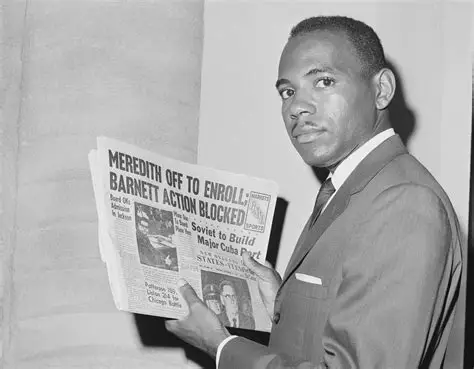
Mississippi Governor Ross Barnett publicly resisted Meredith’s admission and attempted to block his registration. The federal government intervened to enforce the court order.
On September 30, 1962, Meredith arrived at the University of Mississippi campus in Oxford under federal protection. A large white mob gathered and violence erupted around the university’s Lyceum. Federal marshals faced attacks from rioters, and federal troops eventually restored order. Two people died, more than 200 marshals and soldiers suffered injuries, and authorities arrested hundreds of people.
Meredith formally registered for classes in October 1962. His enrollment made him the first African American student to attend the University of Mississippi. The university itself recognizes the event as a major turning point in its history and the breakdown of its segregation barrier.
Life at Ole Miss
Meredith’s time at Ole Miss remained difficult after his admission. Many students isolated him, and some organized efforts to discourage other students from interacting with him. Despite the hostility, he continued attending classes and completed his degree.
He graduated in August 1963 with a bachelor’s degree in political science. His achievement demonstrated that integration involved more than winning admission. Meredith also had to remain at the institution and complete his education despite intense social pressure.
His experience also gave him a lasting connection with the university. Decades later, Ole Miss established the James Meredith Changemaker Award to recognize students who demonstrate commitment to creating educational and social change.
March Against Fear
In 1966, Meredith returned to Mississippi with another ambitious campaign. He began the March Against Fear, a planned 220-mile walk from Memphis, Tennessee, to Jackson, Mississippi. He wanted to encourage Black voter registration and challenge racial intimidation.
On the second day of the march, a gunman shot Meredith several times. He survived the attack and received medical treatment while other civil rights organizations and activists continued the march.
Meredith later rejoined the demonstration and participated in the march’s final stage into Jackson. Thousands of people eventually reached the state capital. The campaign also became associated with an important shift in the civil rights movement, particularly through the growing prominence of the Black Power movement.
Education, Writing and Later Career
Meredith continued his education after graduating from Ole Miss. He studied political science at the University of Ibadan in Nigeria before earning a law degree from Columbia University in New York.
Writing became another important part of his career. He published Three Years in Mississippi in 1966, offering a personal account of his experiences surrounding the integration struggle. He later produced additional autobiographical writings, including A Mission from God: A Memoir and Challenge for America in 2012.
Meredith also pursued political and educational projects. He made an unsuccessful attempt to enter electoral politics and later worked on initiatives that promoted literacy and education. Among these efforts were marches designed to encourage Black Americans to read, write and pursue higher education.
Personal Life
Meredith has generally kept much of his family life outside the center of his public career. His historical importance comes primarily from his civil rights activities, education and writing.
He continued to speak and write about race, education and citizenship throughout his later life. He has also resisted portraying himself simply as a conventional civil rights hero, emphasizing instead his belief that he acted to claim rights that belonged to him as an American citizen.
As of 2026, Meredith remains a living historical figure. His personal papers and records are preserved in the University of Mississippi’s Archives and Special Collections, where they document his family, education, military service, civil rights activities and professional life.
Legacy and Historical Significance
James Meredith’s historical importance rests heavily on his successful challenge to segregation at the University of Mississippi. His legal victory forced a major Southern public university to admit an African American student despite determined state resistance.
His story also illustrates the relationship between individual action and broader civil rights campaigns. Meredith initiated his own legal challenge, while organizations such as the NAACP Legal Defense Fund provided essential legal support. Federal enforcement ultimately made his enrollment possible.
His later March Against Fear showed that his activism did not end with university integration. By promoting voter registration, education and literacy, Meredith continued to challenge barriers affecting African Americans in Mississippi.
The University of Mississippi now preserves extensive archival material documenting his life. The institution also uses his name for an award that recognizes students who pursue meaningful social and educational change.
Meredith’s career therefore belongs to both civil rights history and educational history. His actions helped dismantle a major segregation barrier, while his writings preserved his own interpretation of the events that made him nationally known.
Frequently Asked Questions
Who was James Meredith?
James Meredith is an American civil rights activist, writer and former Air Force serviceman who became the first African American student to enroll at the University of Mississippi.
When did James Meredith integrate Ole Miss?
James Meredith registered at the University of Mississippi in October 1962 after winning a federal court battle that reached the United States Supreme Court.
What happened during the March Against Fear?
Meredith began the 1966 March Against Fear to promote Black voter registration and challenge racial intimidation. A gunman shot him during the second day of the march, but he survived and later rejoined the demonstration.
Did James Meredith study in Nigeria?
Yes. After graduating from the University of Mississippi, Meredith continued studying political science at the University of Ibadan in Nigeria before earning a law degree from Columbia University.
Is James Meredith still alive?
Yes. James Meredith was born in 1933 and remains alive as of 2026.
Conclusion
James Meredith changed American educational history through his determined challenge to racial segregation at the University of Mississippi. His admission followed a major legal struggle, violent resistance and federal intervention, but he completed his degree and continued his education. His later March Against Fear, writing and educational work extended his public contribution beyond the integration of Ole Miss.