|
Getting your Trinity Audio player ready... |
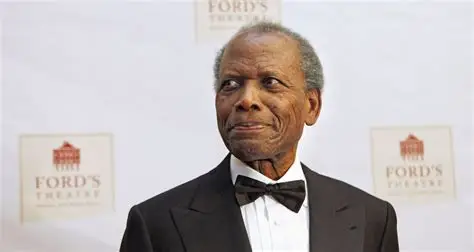
Sidney Poitier was a Bahamian-American actor, director, producer and author who became one of the most important Black performers in American cinema. His breakthrough came during an era when Hollywood offered Black actors relatively few substantial roles. Through films such as The Defiant Ones, Lilies of the Field, In the Heat of the Night and Guess Who’s Coming to Dinner, Poitier helped expand the range of roles available to Black performers.
Poitier was also connected to the American civil rights movement. He participated in the 1963 March on Washington and supported the movement financially and publicly. His career therefore developed alongside a major period of racial change in the United States.
Early Life and Family Background
Sidney Poitier was born on February 20, 1927, in Miami, Florida, to Bahamian parents Reginald James Poitier and Evelyn Outten. His parents operated a farm on Cat Island in the Bahamas, and Poitier spent much of his childhood there. His upbringing in the islands shaped his identity and remained an important part of his later autobiography.
The family lived a modest life, and Poitier experienced rural Bahamian society before moving to the United States as a teenager. His childhood did not follow the conventional path toward a Hollywood career. He left school early and worked to support himself before eventually deciding to pursue acting.
Education and Move to America
At about fifteen, Poitier moved from the Bahamas to Florida. He later relocated to New York City, where he encountered much greater racial discrimination and economic hardship. The Library of Congress records that he worked as a dishwasher, served in the army and initially failed auditions at the American Negro Theater.
These early difficulties forced Poitier to develop his acting abilities while also learning how to navigate an entertainment industry that offered limited opportunities to Black performers. He worked to reduce his Bahamian accent and trained himself to read and perform more effectively.
His persistence eventually led to opportunities on the stage. He joined the American Negro Theater and began gaining experience that would prepare him for professional film roles.
Early Acting Career
Poitier made his Broadway debut in Lysistrata in 1946 and subsequently appeared in stage productions before entering Hollywood. His early film roles were limited, but his performance in No Way Out in 1950 brought greater attention. He played Dr. Luther Brooks, a Black physician treating white criminals while confronting racial hostility.
The role established an important pattern in Poitier’s career. He increasingly played educated, responsible and determined Black characters rather than accepting stereotypical roles. This choice sometimes restricted the kinds of parts available to him, but it also helped redefine the image of Black actors in mainstream American cinema.
Breakthrough in Hollywood
Poitier’s major breakthrough came with Blackboard Jungle in 1955 and The Defiant Ones in 1958. In The Defiant Ones, he played Noah Cullen, a prisoner chained to a white prisoner portrayed by Tony Curtis. The film examined racism and interracial cooperation and earned Poitier his first Academy Award nomination for Best Actor.
He followed this success with Porgy and Bess, A Raisin in the Sun and Lilies of the Field. These films demonstrated his ability to carry major dramatic roles while addressing questions of race, dignity, faith and social change.
Academy Award and Major Films
In 1964, Poitier made history by winning the Academy Award for Best Actor for Lilies of the Field. He portrayed Homer Smith, a traveling handyman who helps a group of German-speaking nuns build a chapel in the Arizona desert. The Academy identifies Poitier as the first African American winner of the Best Actor Oscar.
The award came during the civil rights era and marked an important moment in American entertainment history. Poitier subsequently appeared in several of his most influential films.
In A Patch of Blue (1965), he played a man who befriends a blind white woman. In the Heat of the Night (1967) featured him as Virgil Tibbs, a Black Philadelphia detective investigating a murder in a racially divided Mississippi town. That same year, he starred in Guess Who’s Coming to Dinner, a film about interracial marriage. The Academy lists all three among the major films associated with his career.
Directing Career
Poitier expanded his career beyond acting and became a film director. He directed nine feature films, including Buck and the Preacher (1972), A Warm December (1973), Uptown Saturday Night (1974), Let’s Do It Again (1975) and A Piece of the Action (1977).
His directing work allowed him to participate more directly in filmmaking and commercial cinema. He also demonstrated that Black performers could move into positions of creative control behind the camera.
During the 1980s and 1990s, Poitier continued acting selectively while maintaining his involvement in film and public life.
Civil Rights and Humanitarian Work
Poitier’s career developed alongside the civil rights movement, and he became one of the Hollywood figures associated with the struggle for racial equality. He attended the March on Washington for Jobs and Freedom on August 28, 1963, alongside other prominent entertainers and public figures.
He also maintained close relationships with figures involved in the movement, including Harry Belafonte. His public presence helped connect the entertainment industry with the wider struggle against racial discrimination.
Poitier’s contribution extended beyond his film performances. His autobiography, The Measure of a Man, published in 2000, reflected on his childhood, career, personal values and the experiences that shaped his understanding of responsibility and integrity. The Library of Congress describes the book as an account of his childhood in the Bahamas and his difficult journey toward an acting career.
Personal Life and Family
Poitier married dancer and model Juanita Hardy in 1950. They had four daughters before divorcing in 1965. He married actress Joanna Shimkus in 1976, and they had two daughters.
Poitier remained closely connected to his Bahamian heritage throughout his life. His achievements were also recognized by the Bahamas, where a bridge in New Providence was named the Sir Sidney Poitier Bridge.
Later Years and Death
Poitier received numerous honors during his later years. In 2001, the Academy presented him with an Honorary Award for his accomplishments as an artist and humanitarian.
He also received the Presidential Medal of Freedom from President Barack Obama in 2012. His later public role increasingly centered on reflection, writing and humanitarian recognition rather than regular acting.
Sidney Poitier died at his home in Los Angeles on January 6, 2022, aged 94. The Academy subsequently included him among the filmmakers and performers remembered in its 2022 memorial.
Legacy and Historical Significance
Sidney Poitier’s legacy extends beyond the number of films he made. His career developed when American cinema frequently restricted Black performers to stereotypical supporting roles. By taking leading dramatic parts and insisting on meaningful characters, he helped establish a different model of Black screen representation.
His Oscar victory for Lilies of the Field became a landmark in Academy history. His later films addressed interracial relationships, racial prejudice, professional dignity and social responsibility. His directing career further expanded his contribution by placing him behind the camera as well as in front of it.
Poitier’s significance also lies in the connection between his artistic career and the civil rights era. He was not simply an actor working during a period of social change. He participated in the public life surrounding that change and used his position to support racial equality.
His work remains preserved in American cultural institutions. Lilies of the Field was selected for the National Film Registry in 2020, recognizing its cultural, historical and aesthetic importance.
Frequently Asked Questions
Who was Sidney Poitier?
Sidney Poitier was a Bahamian-American actor, director, producer and author who became a major figure in American cinema and civil rights-era public life.
What was Sidney Poitier’s greatest achievement?
One of his most significant achievements was becoming the first African American to win the Academy Award for Best Actor, for Lilies of the Field in 1964.
What films was Sidney Poitier famous for?
His major films include The Defiant Ones, A Raisin in the Sun, Lilies of the Field, A Patch of Blue, In the Heat of the Night and Guess Who’s Coming to Dinner.
Was Sidney Poitier involved in the civil rights movement?
Yes. He participated in the 1963 March on Washington and supported the broader civil rights struggle.
When did Sidney Poitier die?
Sidney Poitier died on January 6, 2022, at the age of 94.
Conclusion
Sidney Poitier built a historic career by combining acting ability with a determination to challenge the limited roles available to Black performers. From his difficult beginnings in the Bahamas and New York to his Academy Award victory and later directing career, his life reflected major changes in American cinema.
His films remain important records of a period when racial representation was changing rapidly. Through his performances, filmmaking and public service, Poitier became a significant figure in both American film history and the broader story of Black achievement in the twentieth century.