|
Getting your Trinity Audio player ready... |
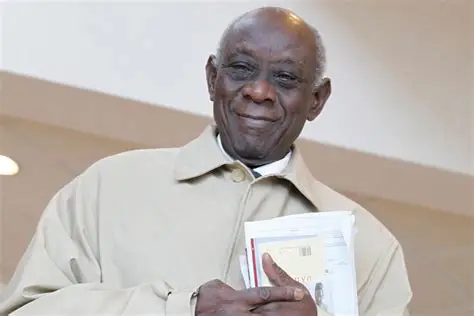
Cheikh Hamidou Kane was a Senegalese novelist, philosopher and statesman whose writing explored the tensions between African cultural identity and Western education. His celebrated novel, Ambiguous Adventure, examined the challenges Africans faced when colonial schooling introduced new ideas while distancing students from their cultural and spiritual traditions. The book became a landmark of Francophone African literature and established Kane as an important voice in debates about identity, education and modernity.
Beyond literature, Kane played a significant role in Senegal’s development after independence. He served in government, held senior administrative positions and worked in international development. He died in Dakar on October 3, 2026, at the age of 98, leaving a legacy that connected African literature with political thought and public service.
Early Life and Education
Cheikh Hamidou Kane was born on April 2, 1928, in Matam, a town in northern Senegal. He grew up in a Muslim family and received an education shaped by both Islamic learning and the French colonial school system. This combination exposed him to different intellectual traditions that later became central to his writing.
Kane first attended a Quranic school, where he studied Islamic teachings and religious texts. He subsequently entered French-language education, experiencing a system designed to prepare selected African students for roles within the colonial administration. The contrast between these educational traditions influenced his understanding of cultural identity and intellectual independence.
He continued his studies in Dakar before travelling to France. At the Sorbonne in Paris, he studied law and philosophy, engaging with European philosophical traditions while reflecting on the experiences of Africans educated under colonial rule. He also attended the École nationale de la France d’outre-mer, which trained administrators for service in France’s overseas territories.
Kane completed his professional training in 1956. By the time he returned to Senegal in 1959, he had developed an understanding of both African cultural traditions and European intellectual thought. This background prepared him for a career in government and gave him the ideas that would later shape his literary work.
Ambiguous Adventure and Literary Recognition
Kane achieved international recognition through L’Aventure ambiguë, published in 1961 and known in English as Ambiguous Adventure. The novel explores the experiences of Samba Diallo, a young Senegalese Muslim whose education takes him away from his community’s traditional religious and cultural environment.
Through Samba’s journey, Kane examines a difficult question: how can Africans acquire knowledge from other cultures without losing their identity? The novel considers the opportunities Western education provides alongside the spiritual and cultural tensions it creates. Rather than offering an easy answer, Kane presents the conflict as a complex struggle involving faith, reason, belonging and personal transformation.
The story draws on the wider experience of colonial Africa, where European educational systems often challenged existing forms of knowledge and authority. Kane’s treatment of this conflict gave the novel relevance beyond Senegal, particularly among readers confronting the consequences of colonialism and the challenges of independence.
Ambiguous Adventure received the Grand Prix littéraire d’Afrique noire in 1962. It became a widely studied work in African literature and reached international audiences through translations into numerous languages. Its enduring importance comes from the questions it raises about education, cultural continuity and the relationship between Africa and the wider world.
Government Career and Political Involvement
Although literature brought Kane international recognition, he devoted much of his working life to building Senegal’s postcolonial state. After returning from France, he entered public service as the country prepared for independence and the creation of new national institutions.
Kane served as governor of the Thiès region around the time Senegal gained independence. He later became a senior official responsible for planning and held ministerial responsibilities in the government of President Léopold Sédar Senghor.
In 1962, Kane served as minister of planning during a major political crisis involving Senghor and Mamadou Dia, the president of the Council of Government. The dispute led to Dia’s arrest and imprisonment. Kane supported Dia and resigned from public service in protest, demonstrating his willingness to take a political position even when it affected his own career.
This episode revealed another dimension of Kane’s character. He was not simply an observer of political developments but an individual who participated in debates over power, governance and the direction of Senegal’s young state.
His later return to government brought further responsibilities. He served as minister of industrial development and handicrafts and subsequently as minister of planning and cooperation. He remained in government until 1988, contributing to discussions about economic development and national policy.
International Development and Public Service
Kane’s public service extended beyond Senegal. From 1967 to 1974, he worked with UNICEF as regional director for West and Central Africa, with assignments in Abidjan, Côte d’Ivoire, and other regional centres during his career. This role connected him with international efforts to improve children’s welfare and development.
His work in international development complemented his experience in national government. Both required him to consider how public institutions could respond to social needs and support long-term progress. His career also reflected a broader commitment to African cooperation and the importance of development policies grounded in local realities.
After returning to Senegal, Kane resumed senior government responsibilities. His experience across administration, literature and international organisations gave him a distinctive perspective on the challenges facing African societies after independence.
Les Gardiens du temple and Later Writing
Kane published his second major novel, Les Gardiens du temple, in 1995, more than three decades after Ambiguous Adventure. The book continued his exploration of African identity, collective memory and the pressures facing newly independent societies.
Where his earlier novel focused on the individual’s struggle between cultural traditions and Western education, Les Gardiens du temple examined broader questions about a society’s ability to preserve its heritage while adapting to political and social change. The work reflected his continuing concern with how communities could pursue progress without abandoning the cultural foundations that gave them meaning.
Kane published relatively few books compared with many other celebrated writers. However, his literary reputation rests largely on the depth of his ideas rather than the size of his bibliography. His novels encouraged readers to consider difficult questions about cultural inheritance, education, religion and the future of African societies.
Death and Legacy
Cheikh Hamidou Kane died in Dakar on October 3, 2026, at the age of 98. His death marked the passing of a major Senegalese intellectual whose life combined literary achievement with public service.
His influence extends across African literature, philosophy and political history. Ambiguous Adventure remains particularly important because it examines a challenge that continues to shape educational and cultural debates: how societies can engage with outside knowledge while maintaining their own identities.
Kane’s government career also forms an important part of his legacy. His service in Senegal’s administration, his resignation during the 1962 political crisis and his work in international development demonstrated his engagement with the practical challenges of building institutions after independence.
He left behind a body of writing that encouraged generations of readers to think critically about tradition, modernity and the meaning of progress. His life illustrates how literature and public service can contribute to a deeper understanding of a nation’s history and place in the world.
Conclusion
Cheikh Hamidou Kane was a novelist, philosopher and statesman whose work helped shape modern African intellectual life. Through Ambiguous Adventure and Les Gardiens du temple, he explored the relationship between cultural identity, education and social change. His public service in Senegal and international development further demonstrated his commitment to the continent’s future. His literary and political legacy continues to encourage reflection on how African societies can embrace new ideas while preserving their cultural heritage.
Frequently Asked Questions
Who was Cheikh Hamidou Kane?
Cheikh Hamidou Kane was a Senegalese novelist, philosopher and statesman best known for Ambiguous Adventure, a novel exploring African identity and Western education.
When was Cheikh Hamidou Kane born?
He was born on April 2, 1928, in Matam, northern Senegal.
What is Cheikh Hamidou Kane’s most famous book?
His best-known book is Ambiguous Adventure, published in 1961. It explores the conflict between traditional African and Islamic values and Western education.
What government positions did Cheikh Hamidou Kane hold?
He served as governor of Thiès and held ministerial responsibilities involving planning, industrial development, handicrafts and cooperation. He also worked as a regional director for UNICEF.
When did Cheikh Hamidou Kane die?
He died in Dakar, Senegal, on October 3, 2026, aged 98.