|
Getting your Trinity Audio player ready... |
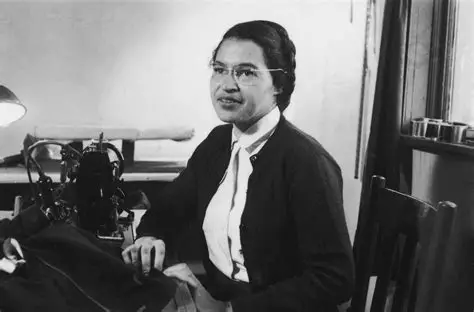
Rosa Parks was an American civil rights activist whose refusal to surrender her bus seat to a white passenger helped spark the Montgomery Bus Boycott of 1955. Her decision challenged racial segregation in public transportation and became a defining moment in the struggle for equal rights in the United States.
Often called the mother of the modern civil rights movement, Parks had spent years working against racial discrimination before her famous arrest. Her commitment to justice extended beyond the Montgomery bus protest into voter registration, youth development, and campaigns against racial inequality.
Parks became an enduring symbol of courage and resistance. Her life demonstrated how an individual act of defiance, supported by organized community action, could help challenge an unjust system.
Who Was Rosa Parks?
Rosa Louise McCauley Parks was born on February 4, 1913, in Tuskegee, Alabama, United States. She grew up during the Jim Crow era, when laws and customs enforced racial segregation across much of the American South.
Parks became involved in civil rights activism through her work with the National Association for the Advancement of Colored People (NAACP). She served as secretary of the Montgomery branch and investigated cases of racial injustice while supporting efforts to improve the rights of African Americans.
Her arrest on December 1, 1955, brought her national attention. After a bus driver ordered her to surrender her seat to a white passenger, Parks refused and the police arrested her. Her case helped mobilize Montgomery’s Black community into a sustained boycott of the city’s buses.
Although the boycott made her famous, Parks was much more than a passenger who refused to move. She was an experienced activist whose determination helped strengthen a wider movement against racial discrimination.
Early Life and Education
Parks was the daughter of James McCauley, a carpenter and stonemason, and Leona Edwards McCauley, a teacher. Her parents separated when she was young, and she spent much of her childhood in Pine Level, Alabama, with her mother and maternal grandparents.
Her grandparents strongly influenced her understanding of racial equality. Growing up in a segregated community, Parks witnessed discrimination and racial intimidation from an early age. These experiences helped shape her determination to resist injustice.
She attended segregated schools in Alabama and later enrolled at the Montgomery Industrial School for Girls, a private institution that emphasized education and discipline. She continued her studies at a laboratory school associated with Alabama State Teachers College for Negroes.
Parks left school during her eleventh year to care for her ill grandmother and mother. She later returned to her studies and earned her high school diploma in 1933, an important achievement for a Black woman during that period.
In 1932, she married Raymond Parks, a barber who supported civil rights and encouraged her involvement in activism. Their marriage became an important source of personal support as they confronted discrimination and financial difficulties.
Rosa Parks and the Montgomery Bus Boycott
Parks became active in the Montgomery NAACP during the 1940s. She served as branch secretary and worked with other activists to investigate racial violence, challenge discrimination, and improve voting rights for African Americans.
Her activism preceded the bus protest by many years. In 1943, she had already clashed with a Montgomery bus driver over the segregation rules that required Black passengers to follow discriminatory boarding procedures.
On December 1, 1955, Parks boarded a city bus after finishing work. When the bus filled with white passengers, the driver ordered Parks and other Black passengers to give up their seats. Parks refused to move, and police arrested her for violating the city’s segregation regulations.
Her arrest provided Montgomery’s Black community with an opportunity to organize a coordinated protest. Civil rights activists, including E. D. Nixon and Jo Ann Robinson, helped mobilize residents to boycott the city’s bus system. The Reverend Martin Luther King Jr. emerged as a leading spokesperson for the campaign.
The Montgomery Bus Boycott began on December 5, 1955, the day of Parks’ trial. Thousands of Black residents stopped using city buses and instead walked, shared rides, or used alternative transportation. The protest placed significant financial pressure on the bus system and demonstrated the strength of organized community action.
Parks was not the first Black woman to challenge bus segregation. Claudette Colvin, a teenager, had refused to surrender her seat earlier in 1955. However, Parks’ established record of activism and her arrest became central to the campaign that followed.
The boycott continued for 381 days. On November 13, 1956, the United States Supreme Court upheld a ruling that segregation on Montgomery’s buses was unconstitutional. The boycott ended on December 20, 1956, after the decision took effect locally.
The campaign became a major victory for the civil rights movement. It also brought Martin Luther King Jr. to national prominence and demonstrated the potential of sustained, nonviolent protest.
Career and Major Achievements
Parks continued working for civil rights after the boycott, but the publicity surrounding her arrest brought serious personal consequences. She lost her job as a tailor’s assistant, while her husband also faced employment difficulties. The couple received threats and struggled to find stable work in Montgomery.
In 1957, Parks and her family moved to Detroit, Michigan, seeking better opportunities. The move did not immediately resolve their financial difficulties, but she remained committed to civil rights activism.
She continued supporting voter registration, housing equality, and campaigns against racial discrimination. Parks participated in major civil rights gatherings, including the 1963 March on Washington, and maintained her association with the NAACP.
In 1965, she began working in the Detroit congressional office of John Conyers Jr. She served as an administrative aide until her retirement in 1988. Her work included helping constituents, particularly people who faced difficulties obtaining housing and accessing public services.
Parks also devoted attention to young people. In 1987, she co-founded the Rosa and Raymond Parks Institute for Self Development. The organization aimed to educate young people about civil rights, leadership, and personal responsibility.
Her contributions received major national recognition. In 1996, President Bill Clinton awarded her the Presidential Medal of Freedom. In 1999, she received the Congressional Gold Medal, one of the highest civilian honors in the United States.
These awards recognized a lifetime of commitment to racial equality rather than a single moment on a bus.
Personal Life and Death
Parks and her husband did not have children. Raymond remained an important supporter of her civil rights work until his death in 1977. She continued living and working in Detroit, where she remained connected to community organizations and public causes.
Despite her growing national recognition, Parks experienced periods of financial hardship and personal loss. Her later years included continued advocacy, public appearances, and efforts to preserve the history of the civil rights movement.
Rosa Parks died on October 24, 2005, in Detroit, Michigan, at the age of 92. Her death prompted tributes across the United States and internationally.
She became the first woman to lie in honor in the United States Capitol Rotunda. Thousands of people paid their respects, reflecting the national significance of her contribution to American history.
Rosa Parks’ Legacy and Influence
Rosa Parks helped change the course of American civil rights history by challenging segregation and inspiring collective action. The Montgomery Bus Boycott demonstrated how sustained protest could confront discriminatory laws and encourage legal reform.
Her work also challenged the simplified idea that civil rights activism began with one isolated act of courage. Parks had spent years organizing, investigating racial injustice, and supporting community campaigns before her arrest. Her experience illustrates the importance of preparation, local leadership, and collective determination in social movements.
The Rosa and Raymond Parks Institute for Self Development continues to reflect her commitment to education and youth leadership. Schools, museums, public spaces, and commemorations also preserve her story for future generations.
Parks’ influence extends beyond transportation and American racial history. Her life remains an example of how people can resist unjust rules and contribute to wider social change through persistence and organized action.
Conclusion
Rosa Parks was a lifelong civil rights activist whose refusal to surrender her bus seat helped ignite one of the most significant protests against racial segregation in American history. Her work with the NAACP, role in the Montgomery Bus Boycott, and later community service reflected a sustained commitment to equality.
Although her arrest brought her international recognition, her legacy rests on decades of activism and determination. Rosa Parks remains an important figure in the history of civil rights, voting rights, and the struggle for equal treatment under the law.
SEO Title: Rosa Parks Biography: Civil Rights Activist
Focus Keyword: Rosa
Meta Description: Discover Rosa Parks’ biography, early life, civil rights activism, Montgomery Bus Boycott, major achievements, and lasting influence on American history.
Slug: rosa-parks-biography
Related Keywords: Rosa Parks civil rights activist, Rosa Parks bus boycott, Rosa Parks early life, Montgomery Bus Boycott, Rosa Parks achievements, NAACP, American civil rights movement
Tags: