|
Getting your Trinity Audio player ready... |
Mansa Musa Biography: The Mali Empire’s King
Introduction
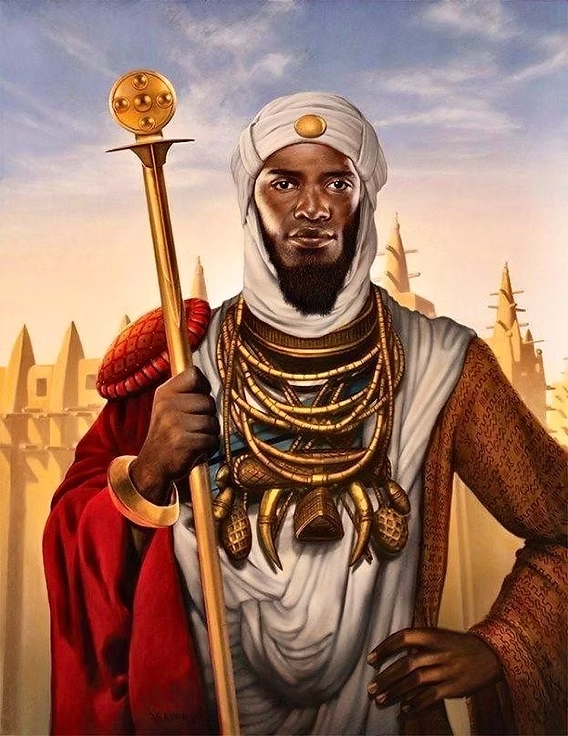
Mansa Musa was the celebrated ruler of the Mali Empire in West Africa during the 14th century. Remembered for his immense royal wealth, support for Islamic scholarship, ambitious building projects, and historic pilgrimage to Mecca, he became one of the most famous African monarchs in world history. His reign helped establish Mali as a major center of commerce, religion, learning, and political power.
Mansa Musa ruled at a time when West Africa was connected to extensive trade networks that linked the Sahara Desert with North Africa, the Mediterranean, and the wider Islamic world. Gold from the region was in high demand, while salt, textiles, books, and other goods moved through important commercial centers. By exercising authority over a powerful empire and its trade routes, Musa presided over a kingdom whose influence extended far beyond its borders.
His journey to Mecca around 1324 became legendary. Accounts of the pilgrimage describe a royal procession of extraordinary scale, with attendants, officials, travelers, and large quantities of gold. The journey attracted attention in North Africa and the Middle East and helped bring the Mali Empire to wider international notice.
Yet Mansa Musa’s historical importance goes beyond the stories of his riches. His reign is associated with the development of Timbuktu as a center of Islamic learning, the growth of royal patronage, and the expansion of Mali’s reputation across the medieval world. His biography offers a window into the sophistication, ambition, and achievements of one of Africa’s most influential historical kingdoms.
Who Was Mansa Musa?
Mansa Musa was the emperor of the Mali Empire, a powerful medieval West African state that controlled important territories and commercial routes across parts of present-day Mali and neighboring regions. The word mansa is commonly translated as king or ruler in the context of the Mali Empire.
He is generally identified by historians as Musa I of Mali. He came to the throne around 1312, although the precise chronology of early Mali rulers is not entirely certain. His reign continued until approximately 1337, when he was succeeded by another member of the ruling dynasty.
Musa governed an empire whose wealth depended partly on gold production, agriculture, regional commerce, taxation, and control of trans-Saharan trade. The state also benefited from its position between North African trading centers and the gold-producing regions farther south.
As a Muslim monarch, Musa strengthened Mali’s connections with the wider Islamic world. He supported religious institutions and is associated with the construction and development of mosques and centers of learning. His rule helped make Mali better known to foreign merchants, scholars, and political authorities.
Although modern popular accounts often describe him simply as the richest man in history, the surviving evidence does not allow historians to calculate his personal wealth accurately. His historical significance is better understood through the scale of his empire, the resources available to its government, his international pilgrimage, and his support for religious and educational institutions.
Mansa Musa’s Age, Birth and Early Life
Mansa Musa’s exact birth date is unknown. Historians commonly place his birth around 1280, although this is an estimate rather than a date confirmed by surviving contemporary records. If this estimate is correct, he was in his early to mid-40s during his famous pilgrimage to Mecca.
He was born into the ruling family of the Mali Empire, which had emerged as a major West African power during the 13th century. The dynasty was associated with Sundiata Keita, the celebrated founder of the empire whose victory over the Sosso kingdom helped establish Mali’s political foundations.
Details about Musa’s childhood remain limited. Unlike many modern royal biographies, the historical record does not provide a reliable account of his childhood education, personal relationships, or daily life before he became ruler. Much of what historians know about him comes from Arabic-language chronicles, accounts written by travelers, and later historical traditions.
Mali’s political system combined royal authority with the responsibilities of regional leaders and court officials. Its territories included farming communities, trading settlements, and areas connected to the trans-Saharan gold trade. A ruler needed to maintain relationships with local authorities, protect commercial interests, and preserve the loyalty of the empire’s diverse populations.
Musa inherited this political environment and became the head of a state that already possessed considerable economic resources. His achievement was not the creation of Mali from nothing, but the strengthening of its international reputation and the use of its wealth to support royal and religious ambitions.
Education and Religious Background
There is no sufficiently detailed surviving record identifying the schools Mansa Musa attended or establishing formal academic qualifications. It would therefore be misleading to assign him a particular degree, institution, or educational title.
His reign, however, demonstrates the importance of Islamic learning within the royal court. Islam had been established among sections of West African trading communities and ruling elites before Musa’s time. Commercial relations with North Africa helped spread religious scholarship, Arabic literacy, and connections with Muslim intellectual centers.
Musa was a Muslim ruler who regarded pilgrimage to Mecca as an important religious obligation. His journey also placed him in contact with scholars, merchants, officials, and other influential people across the Islamic world.
The royal court’s relationship with Islamic scholarship contributed to Mali’s growing reputation. Religious learning was connected to law, administration, diplomacy, manuscript culture, and the education of future scholars.
It is important, however, to distinguish between what is known about Musa personally and what is known about his kingdom. The growth of Islamic education in Mali was a broader historical process involving scholars, merchants, teachers, builders, and local communities, not the work of one ruler alone.
Mansa Musa’s Rise to the Throne
Mansa Musa became ruler of the Mali Empire around 1312, although the precise chronology of his accession remains subject to historical debate.
Accounts of his rise to power include a story that his predecessor, often identified in popular retellings as Abu Bakr II, appointed Musa as his deputy before departing on an expedition across the Atlantic Ocean. According to this tradition, the expedition never returned, leaving Musa to assume the throne.
Historians approach this story cautiously. The surviving historical evidence does not securely establish the popular account of an emperor who sailed westward into the Atlantic and disappeared. Interpretations of the names and succession records of early Mali rulers also differ among scholars.
What can be stated with greater confidence is that Musa emerged as the leading ruler of Mali during the early 14th century. He inherited a powerful state with established political institutions and access to valuable commercial networks.
His reign would bring Mali to the attention of audiences far beyond West Africa. The pilgrimage to Mecca, in particular, transformed the reputation of its ruler from that of a distant regional monarch into a figure recognized in accounts and maps produced outside Africa.
Mansa Musa’s Wealth and the Gold Trade
Mansa Musa’s reputation for wealth is among the most enduring aspects of his historical identity. His empire benefited from the gold trade that connected West African production areas with North African and Mediterranean markets.
Gold was an important commodity in medieval international commerce. Merchants transported it across the Sahara, exchanging it for salt, textiles, horses, books, and other goods. Salt was particularly valuable in many West African communities because of its importance to food preservation and human nutrition.
Mali’s position within these commercial networks gave its rulers access to substantial economic resources. Royal revenues could be derived from trade, tribute, agricultural production, and the administration of territories under imperial authority.
However, the idea that Musa personally owned every gold-producing area within his empire is an oversimplification. Medieval states did not necessarily operate like modern corporations with centralized ownership of every resource. Gold production and distribution involved different communities, traders, local authorities, and political relationships.
Why Was Mansa Musa So Rich?
Musa’s wealth was closely associated with Mali’s position in the gold trade and the resources available to its government. His political authority allowed him to command substantial wealth and organize a royal court capable of undertaking expensive journeys and supporting major projects.
His pilgrimage demonstrated this wealth on an extraordinary scale. The gold he carried and distributed became a subject of discussion in Cairo, where observers recorded the arrival of the West African monarch.
Stories about his riches subsequently circulated across the Mediterranean world. His image appeared on a famous 14th-century Catalan world map, produced in 1375, depicting the ruler of Mali holding a gold object.
The map is significant because it demonstrates that Musa’s fame survived beyond his lifetime and became part of the geographical knowledge of medieval Europe.
Was Mansa Musa the Richest Person in History?
Mansa Musa is frequently described as the richest person who ever lived. Although the description captures the scale of his historical reputation, there is no reliable method for calculating his personal fortune and comparing it precisely with the wealth of individuals from other periods.
His wealth existed within a medieval economy, where royal resources, tribute, control of trade, and personal possessions were closely connected but not necessarily identical.
Modern estimates that assign him a specific net worth in today’s dollars should therefore be treated as speculation. No surviving financial records provide a dependable figure.
The stronger historical conclusion is that Musa ruled one of the important economic powers of medieval West Africa and possessed sufficient resources to make his pilgrimage an international event.
Mansa Musa’s Historic Pilgrimage to Mecca in 1324

Mansa Musa’s pilgrimage to Mecca, undertaken around 1324 and continuing into 1325, is the best-documented episode of his reign. Known as the Hajj, the journey was a religious obligation for Muslims who were able to undertake it.
For Musa, the pilgrimage also became a remarkable display of Mali’s political and economic strength.
The royal party traveled north through Saharan routes before reaching Cairo, one of the most important cities in the medieval Islamic world. From there, the journey continued toward the holy cities of Arabia.
Accounts describe a large procession that included members of the royal household, officials, attendants, merchants, and other travelers. The exact size of the party is disputed, and some traditional figures may have been exaggerated. Nevertheless, the journey was clearly substantial enough to attract considerable attention.
What Happened When Mansa Musa Visited Cairo?
Musa’s arrival in Cairo impressed local observers because of the scale of his entourage and the quantity of gold associated with the royal party.
Accounts preserved by later writers describe Musa distributing gold to people he encountered and making gifts to important individuals. His generosity helped establish his reputation as a ruler of extraordinary resources.
The movement of so much gold through Cairo also affected the local market. Historical accounts report a decline in the value of gold following his visit, with the effects said to have lasted for years.
The precise scale and duration of this economic impact are difficult to establish from the surviving evidence. It is nevertheless an important indication of how a West African monarch’s decisions could influence a major commercial center outside his own empire.
Musa’s visit also created opportunities for diplomacy and cultural exchange. His presence demonstrated that Mali was not an isolated kingdom but an active participant in a broad network of commercial, religious, and political relationships.
What Did Mansa Musa Bring Back to Mali?
Musa’s pilgrimage strengthened his connections with the Islamic world. His return is associated with the movement of scholars, religious specialists, and architects to Mali, although the details of individual appointments and construction projects are not equally well documented.
These connections helped reinforce the place of Islamic learning within the empire. They also contributed to the development of urban centers where trade, religious activity, and scholarship could flourish.
The pilgrimage became one of the defining events of Musa’s reign because it connected his religious commitments with his political influence and Mali’s international standing.
Mansa Musa’s Achievements as King of Mali
Mansa Musa’s legacy rests on several important aspects of his reign. His wealth attracted attention, but his influence also extended to diplomacy, religious patronage, urban development, and the growth of scholarly institutions.
1. Strengthening Mali’s International Reputation
One of Musa’s most significant achievements was bringing the Mali Empire to greater international attention.
His pilgrimage placed him before observers in Cairo and other parts of the Islamic world. Reports of his wealth and royal procession circulated among scholars and travelers, while his image eventually appeared on European cartography.
This recognition helped establish Mali as a major political and commercial power in the medieval world.
2. Supporting Islamic Architecture
Musa is associated with the patronage of mosques and other religious buildings. Such projects served practical religious purposes while also expressing the authority and resources of the royal court.
Traditional accounts connect his reign with the construction and development of important mosques in Mali. However, the histories of individual buildings are complex, and some structures were rebuilt, expanded, or modified after his death.
The architectural history of the region reflects the combined contributions of rulers, builders, religious communities, and successive generations.
3. Promoting Scholarship and Religious Learning
Mali’s growth as a center of Islamic scholarship is another important part of Musa’s legacy.
Timbuktu developed into a significant center of commerce and learning over time. Its scholars, manuscript collections, religious institutions, and trading communities later became widely recognized across the Islamic world.
Musa’s patronage contributed to the conditions that supported this development, although Timbuktu’s reputation was shaped by many people and continued to grow under later rulers.
4. Supporting Urban Development
The growth of cities was closely connected to the economic and political strength of Mali. Commercial settlements benefited from trade, while religious and educational institutions attracted scholars and students.
Musa’s reign is associated with investment in important urban centers, particularly Timbuktu. The combination of commerce, royal patronage, and scholarship helped establish foundations for the city’s later historical importance.
5. Expanding Diplomatic Connections
Musa’s pilgrimage helped strengthen Mali’s connections with political and religious authorities beyond West Africa.
Diplomatic relationships could improve a ruler’s standing, create opportunities for commerce, and facilitate the movement of scholars and skilled workers. These contacts also helped foreign observers learn more about Mali’s resources and political organization.
His reign illustrates how medieval African rulers participated in international affairs through diplomacy, religion, trade, and personal relationships between courts.
Mansa Musa and the Development of Timbuktu

Timbuktu is one of the cities most closely associated with Mansa Musa’s historical legacy. Situated near the Niger River’s broader commercial region and the southern edge of the Sahara, the city occupied a strategic position in networks linking West African communities with trans-Saharan merchants.
During the medieval period, its importance rested on more than religion. Timbuktu was also a trading center where goods, travelers, ideas, and manuscripts moved between different regions.
Musa’s reign is connected with the development of the city’s religious architecture and scholarly life. The Djingareyber Mosque, in particular, is traditionally associated with his period of rule and with the architect Abu Ishaq al-Sahili, who is said to have accompanied Musa after the pilgrimage.
The details of al-Sahili’s role and the building’s construction history have been discussed by historians. It is therefore important not to treat every later account of the project as an independently confirmed fact.
Timbuktu’s later reputation as a major center of Islamic learning developed over generations. Its scholarly traditions included teaching, manuscript production, legal studies, theology, and other fields of knowledge.
The city’s famous manuscript heritage reflects the intellectual activity of West African scholars and communities. These achievements challenge older assumptions that medieval African societies lacked sophisticated traditions of written learning.
Musa deserves recognition for his association with royal patronage during an important period in Mali’s history, but the intellectual history of Timbuktu belongs to the wider society that sustained its institutions.
Mansa Musa’s Family, Wife and Children
Historical information about Mansa Musa’s private family life is limited compared with what is known about his pilgrimage and reign.
Some accounts associate him with a royal consort commonly referred to as Inari Kunate. However, surviving evidence does not provide the kind of comprehensive family record available for many modern public figures, and details of royal relationships should be treated cautiously.
Musa had a son named Maghan, who succeeded him as ruler of Mali. The succession is an important part of the political history of the empire because it shows the continuation of the ruling dynasty after Musa’s death.
His successor’s reign was considerably less famous internationally than Musa’s. Nevertheless, Maghan’s rule formed part of the continuing history of the Mali monarchy.
Musa also belonged to the broader Keita royal tradition associated with the Mali Empire’s foundation. The dynasty’s political authority was connected to inherited legitimacy, relationships among members of the ruling family, and the ability to maintain support among influential court figures.
There is insufficient reliable information to provide a complete list of Musa’s children, establish every marital relationship, or reconstruct his household in detail. A responsible historical biography should acknowledge these gaps rather than fill them with unsupported claims.
Mansa Musa’s Death and Succession
The exact year of Mansa Musa’s death remains disputed. Many historical accounts place it around 1337, while other interpretations of the surviving chronology suggest that he may have died as early as 1332.
The uncertainty arises partly from differences in medieval Arabic historical accounts and the difficulty of reconciling the reported reigns and succession dates of Mali’s rulers.
His son Maghan succeeded him, although the details of the transition are not fully documented. Musa’s death did not immediately end Mali’s power, and the empire continued to play a major role in West African political and commercial life.
Later rulers inherited a state whose reputation had been strengthened by Musa’s reign. However, Mali’s subsequent history included political challenges and changes in regional power, demonstrating that even a wealthy empire depended on effective leadership, stable institutions, and control of its territories.
Musa’s death marked the end of one of the most internationally visible reigns in medieval West African history, but the institutions and commercial networks associated with his era continued to shape the region.
Mansa Musa’s Historical Legacy
Mansa Musa remains an important figure in African and world history because his reign provides evidence of the political sophistication and international connections of medieval West African societies.
His pilgrimage demonstrated that a ruler based south of the Sahara could command enormous resources and participate in the religious and diplomatic life of the wider Islamic world. His reputation also shows how trade could connect African economies with distant markets and influence events beyond a ruler’s immediate territory.
His association with Timbuktu highlights the relationship between wealth, religious patronage, urban life, and education. The city’s later scholarly achievements became an enduring part of West Africa’s intellectual heritage.
Musa’s fame has also helped challenge historical narratives that give insufficient attention to Africa’s precolonial kingdoms. The Mali Empire had political institutions, commercial networks, religious traditions, and centers of learning that deserve consideration on their own historical terms.
At the same time, historians must distinguish between documented events and later legends. Popular claims about Musa’s exact fortune, the size of his pilgrimage, or the details of his private life often go beyond what the evidence can establish.
His historical importance does not depend on exaggerated numbers. His reign, pilgrimage, and association with Mali’s commercial and intellectual development are sufficient to explain why he continues to attract attention centuries after his death.
Conclusion
Mansa Musa was a medieval West African monarch whose reign brought the Mali Empire international recognition. His wealth reflected the resources and commercial importance of his kingdom, while his pilgrimage to Mecca in 1324 and 1325 created enduring connections with the wider Islamic world.
His association with Islamic architecture, religious scholarship, and the development of Timbuktu forms an important part of his legacy. Although some details of his life remain uncertain, his historical significance is well established.
Mansa Musa’s story is not simply a tale of gold and royal extravagance. It is also the history of a powerful African state, its participation in international commerce, and its contribution to the political and intellectual life of the medieval world.
Frequently Asked Questions About Mansa Musa
1. Who was Mansa Musa?
Mansa Musa was the ruler of the Mali Empire in West Africa during the 14th century. He is remembered for his wealth, pilgrimage to Mecca, international reputation, and association with Islamic scholarship and architecture.
2. When was Mansa Musa born?
His exact birth date is unknown. Historians commonly estimate that he was born around 1280, but no surviving contemporary record confirms the precise year.
3. How old was Mansa Musa when he died?
His age at death cannot be established precisely because neither his birth date nor his death year is certain. If he was born around 1280 and died around 1337, he would have been approximately 57 years old.
4. Was Mansa Musa the richest man in history?
He is widely described as one of history’s wealthiest rulers. However, his personal fortune cannot be calculated reliably or compared precisely with modern billionaires because medieval royal wealth was recorded differently from modern personal assets.
5. Who was Mansa Musa’s wife?
Some historical accounts associate Mansa Musa with a royal consort called Inari Kunate. Detailed, independently verified information about his marital life is limited.
6. Did Mansa Musa have children?
Yes. His son Maghan succeeded him as ruler of the Mali Empire. A complete and reliably documented list of his children is not available.
7. What was Mansa Musa famous for?
He was famous for ruling the wealthy Mali Empire, undertaking an extraordinary pilgrimage to Mecca, distributing gold during his travels, and supporting religious and scholarly institutions.
8. What were Mansa Musa’s greatest achievements?
His principal historical achievements include strengthening Mali’s international reputation, connecting the empire more visibly with the wider Islamic world, and supporting developments in religious architecture and scholarship.
9. Did Mansa Musa build Timbuktu?
Timbuktu existed before Musa’s reign. He is associated with patronage that contributed to its development, but the city grew through the combined efforts of rulers, merchants, scholars, builders, and local communities over several generations.
10. When did Mansa Musa die?
His death is commonly dated to approximately 1337, although some historians place it around 1332. The disagreement reflects uncertainties in the surviving medieval chronology.