|
Getting your Trinity Audio player ready... |
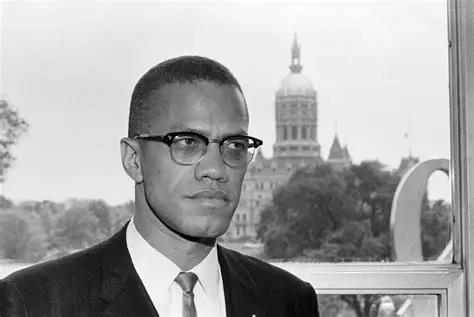
Malcolm X was an American Muslim minister, human rights activist, and influential voice of Black nationalism whose ideas shaped debates about race, identity, equality, and political power in the United States. Born Malcolm Little on May 19, 1925, in Omaha, Nebraska, he experienced racism, family hardship, institutional discrimination, imprisonment, religious transformation, and political activism before becoming one of the most recognizable Black leaders of the 20th century.
His public career lasted only a few years, but Malcolm X developed from a prominent spokesman for the Nation of Islam into an independent Muslim leader who increasingly viewed the struggle for Black freedom through an international human rights perspective. His assassination on February 21, 1965, ended his life at age 39, but it did not end the influence of his ideas.
Early Life of Malcolm X
Malcolm Little was born to Earl Little and Louise Little. His father was a Baptist minister and an active supporter of Marcus Garvey’s Black nationalist movement. The family faced hostility from white supremacists, and Malcolm’s childhood was marked by racial discrimination and instability.
After his father’s death and his mother’s institutionalization, Malcolm and his siblings entered foster and other forms of care. His experiences with racism continued during his education. Although he was an intelligent student, he later recalled that a teacher discouraged his ambition to become a lawyer because such a career was considered unrealistic for a Black student.
Malcolm eventually left school and moved between several American cities. During his years in Boston and New York, he became involved in criminal activity and adopted the street name “Detroit Red.” His activities eventually led to imprisonment in 1946.
Malcolm X and the Nation of Islam
Prison became a turning point in Malcolm Little’s life. While incarcerated, he encountered the teachings of the Nation of Islam, a religious and Black nationalist movement led by Elijah Muhammad. Malcolm embraced the movement and began educating himself extensively through reading and correspondence.
After his release in 1952, he joined the Nation of Islam in earnest and changed his surname to X. The name represented the African family identity that he believed had been erased through slavery.
Malcolm quickly became an exceptionally effective speaker and organizer. His powerful rhetoric, disciplined approach, and ability to attract public attention helped expand the Nation of Islam’s visibility. He eventually became one of its most prominent ministers and public representatives.
During this period, Malcolm X strongly rejected racial integration as the immediate solution to America’s racial problems. He argued for Black self-determination, economic independence, community control, and the right of Black Americans to defend themselves against racial violence.
Malcolm X as a Civil Rights Era Leader
Malcolm X emerged during a period when the United States was experiencing major struggles over segregation and civil rights. His approach differed sharply from that of leaders who emphasized interracial integration and nonviolent protest.
He criticized what he regarded as the limitations of the mainstream civil rights movement. Malcolm argued that Black Americans should not depend on white political institutions to determine the terms of their freedom. His speeches attracted enormous attention because they addressed racial injustice with unusual directness.
He also became an international figure. His speeches discussed colonialism, African independence, racism, poverty, religion, and the political position of Black people around the world. This broader outlook distinguished him from a purely domestic civil rights spokesman.
Malcolm’s influence also created controversy. His uncompromising language and criticism of white America made him a deeply polarizing figure. Yet his ability to articulate Black anger and demand dignity gave him a powerful following among people who believed conventional political approaches had failed.
Break With Elijah Muhammad
Malcolm X’s relationship with Elijah Muhammad eventually deteriorated. He became increasingly dissatisfied with the Nation of Islam’s internal leadership and its refusal to participate more directly in the civil rights struggle.
Tensions intensified after Malcolm made controversial comments following the assassination of President John F. Kennedy in November 1963. The Nation of Islam suspended him, and he eventually left the organization in March 1964.
His departure marked a major transformation in his political and religious life.
Malcolm founded Muslim Mosque, Inc., and later established the Organization of Afro-American Unity. He continued to advocate Black empowerment but began reconsidering some of the racial assumptions that had shaped his earlier public career.
Malcolm X’s Journey to Mecca
In 1964, Malcolm X made a pilgrimage to Mecca, an experience that significantly influenced his worldview. He encountered Muslims from different racial and ethnic backgrounds and observed people of different skin colors participating together in Islamic worship.
The experience challenged some of his earlier beliefs about race. Malcolm began distinguishing between racism itself and individual white people. He increasingly argued that racial injustice should be understood as a human rights issue rather than solely as an American civil rights dispute.
He also traveled through parts of Africa and the Middle East, meeting political leaders and observing the continent’s emerging independence movements. These experiences strengthened his interest in international politics and African affairs.
Although Malcolm retained a strong commitment to Black political empowerment, his later thinking was more complex than the separatist position associated with his Nation of Islam years.
Assassination of Malcolm X
Malcolm X faced increasing hostility after leaving the Nation of Islam. In February 1965, his family home in New York was firebombed while he and his family were inside. He continued with his public activities despite the threats.
On February 21, 1965, Malcolm X was preparing to address a meeting of the Organization of Afro-American Unity at the Audubon Ballroom in Manhattan. Gunmen attacked him as he stood before the audience.
Malcolm X was 39 years old.
Three men were convicted in connection with his assassination. The circumstances surrounding the killing and the responsibilities of the various individuals and organizations involved have remained subjects of historical debate.
His death shocked the United States and international audiences. The assassination also transformed Malcolm X from a controversial contemporary activist into a lasting symbol of Black political consciousness.
The Autobiography of Malcolm X
One of the most important works associated with Malcolm X is The Autobiography of Malcolm X, written with journalist Alex Haley. The book was published after Malcolm’s death in 1965.
The autobiography traces his childhood, criminal years, conversion to Islam, rise within the Nation of Islam, break with Elijah Muhammad, pilgrimage to Mecca, and evolving political philosophy.
The book became one of the most influential autobiographical works connected to the Black experience in America. It has remained important to students, historians, activists, writers, and readers examining race, religion, identity, and political transformation.
Legacy of Malcolm X
Malcolm X’s legacy extends far beyond his speeches and political organizations. He became a major symbol of Black pride, self-determination, intellectual independence, and resistance to racial oppression.
His emphasis on African identity also influenced later discussions of Black history and global African solidarity. His changing views demonstrate that political thought can evolve through experience, travel, study, religious reflection, and engagement with people from different backgrounds.
Malcolm X also occupies an important place in the history of Black political thought because he challenged Americans to consider whether racial equality could exist without economic, political, and social power for Black communities.
His influence continued after his death through books, documentaries, academic studies, political movements, music, literature, and popular culture. His speeches remain widely studied because they capture both the anger of the civil rights era and the intellectual development of a leader who continued questioning his own ideas.
Why Malcolm X Remains Historically Important
Malcolm X remains historically important because his life illustrates a remarkable transformation. He moved from a troubled childhood and criminal life to prison, religious commitment, national leadership, international activism, and an increasingly nuanced understanding of race and human rights.
His story also reveals the complexity of the American civil rights era. The struggle for Black freedom contained many competing philosophies, including integration, nonviolence, Black nationalism, religious activism, economic independence, and international human rights advocacy.
Malcolm X did not live long enough to complete the political program he was developing in his final year. Nevertheless, his willingness to reconsider earlier positions became an important part of his historical legacy. He remains remembered not only for what he believed, but also for his capacity to change.
Conclusion
Malcolm X was one of the most influential Black leaders of the 20th century. His life moved through hardship, crime, imprisonment, religious transformation, political activism, international travel, and intellectual development.
His transition from Malcolm Little to Malcolm X and finally El-Hajj Malik El-Shabazz reflected a broader search for identity and purpose. Although his life ended violently in 1965, his writings, speeches, and political ideas continued to influence generations.
Malcolm X’s enduring importance lies in the questions he forced society to confront: Who controls the meaning of freedom? How should oppressed people respond to injustice? Can political beliefs change through experience? His legacy remains significant because those questions continue to shape discussions about race, equality, identity, and human rights.