|
Getting your Trinity Audio player ready... |
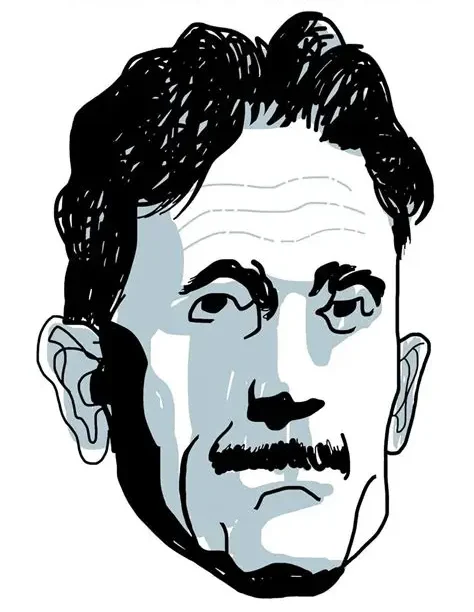
George Orwell was an English novelist, essayist, journalist and political writer whose work became central to modern discussions of power, propaganda, poverty and political freedom. Born Eric Arthur Blair in British India in 1903, he spent much of his life examining the gap between political ideals and lived reality. His experiences in Burma, among Britain’s poor and during the Spanish Civil War shaped the ideas behind his most influential books.
Orwell is best known for Animal Farm and Nineteen Eighty-Four, but his historical importance extends across fiction, journalism and political commentary. He died at only 46, yet his writing continued to influence debates about totalitarianism, censorship, political language and individual freedom.
Early Life and Family Background
Eric Arthur Blair was born on June 25, 1903, in Motihari, Bengal, then part of British India. His father, Richard Walmesley Blair, worked in the Indian Civil Service’s Opium Department. His mother, Ida Mabel Limouzin Blair, came from a family with connections to the colonial world.
The family returned to England when Orwell was young. He grew up mainly in England with his mother and two sisters. His family occupied what he later described as a lower-upper-middle-class position, giving him an early understanding of both privilege and social hierarchy.
He attended St Cyprian’s School in Eastbourne before winning a King’s Scholarship to Eton College. He left Eton in 1921 without attending university. The following year, he joined the Indian Imperial Police in Burma.
Burma and the Rejection of Empire
Orwell spent five years serving as a police officer in Burma. The experience placed him directly inside the British imperial system that he had once accepted as a career.
His growing discomfort with colonial rule eventually became a defining part of his political development. He later transformed his experiences into the novel Burmese Days and essays such as A Hanging and Shooting an Elephant. These works examined the moral pressures and violence built into imperial authority.
He resigned from the police after returning to England in 1927. Instead of pursuing a conventional professional career, he began deliberately experiencing poverty and insecure work. This decision changed both his life and his writing.
Poverty and Becoming a Writer
During the early 1930s, Orwell lived in Paris and London and experienced poverty at close range. He worked in restaurants, stayed in cheap accommodation and sometimes lived among people surviving on casual labour.
He turned these experiences into Down and Out in Paris and London, published in 1933. It was his first published book and introduced the pen name George Orwell. The name combined George, after the reigning king, with the River Orwell in Suffolk.
Orwell continued writing novels and journalism while working as a teacher and later in a Hampstead bookshop. His early novels included A Clergyman’s Daughter and Keep the Aspidistra Flying. His writing increasingly focused on class, money, social inequality and the struggle to maintain personal dignity.
Political Development and the Spanish Civil War
Orwell’s political views developed through direct experience rather than abstract theory. He became increasingly committed to democratic socialism while remaining deeply hostile to authoritarian politics.
His 1937 book The Road to Wigan Pier examined unemployment, poverty and working-class conditions in northern England. The book also revealed his growing interest in socialism and the difficulties surrounding class politics.
The decisive political experience came in Spain. Orwell travelled there in late 1936 and joined Republican forces fighting Francisco Franco. He served with the anti-Stalinist POUM militia and was wounded by a bullet in the throat in 1937.
He also witnessed conflict among factions on the Republican side. The suppression of the POUM and the role of Soviet-backed communists profoundly affected his political thinking. He became increasingly convinced that revolutionary politics could itself become oppressive when power and truth were controlled by authoritarian institutions.
Orwell recorded these experiences in Homage to Catalonia, published in 1938. The book became one of the most important firsthand accounts of the Spanish Civil War and strengthened his opposition to totalitarian communism.
Journalism, War and Political Writing
Poor health prevented Orwell from serving in the British military during the Second World War. He instead worked in broadcasting and journalism. From 1941 to 1943, he worked for the BBC’s Eastern Service before becoming literary editor of the socialist magazine Tribune.
During this period, Orwell wrote extensively about politics, literature and British society. His essays examined nationalism, patriotism, propaganda and the relationship between language and political power.
His political writing was distinctive because he distrusted political slogans when they replaced honest thought. He believed writers had a responsibility to describe reality clearly, even when the truth challenged their own political side.
Animal Farm and International Fame
Orwell wrote Animal Farm in the early 1940s, but publishers initially hesitated to release it. The novel was a political satire of the Soviet system and the betrayal of revolutionary ideals under Stalinism. It was finally published in August 1945.
The book became an international success. Its story of animals overthrowing their human owner and gradually creating another oppressive hierarchy offered a simple but powerful examination of political corruption.
Orwell’s achievement was not merely attacking one government. He explored how political movements can replace one form of domination with another. The novel’s continuing popularity helped make his name synonymous with clear political fiction.
Nineteen Eighty-Four
Orwell’s final novel, Nineteen Eighty-Four, was published in June 1949. Set in a future authoritarian society, it follows Winston Smith as he struggles against a government that controls information, language, history and private thought.
The novel developed ideas that had occupied Orwell throughout his career. It examined surveillance, propaganda, censorship and the manipulation of truth. Terms and concepts associated with the book, including Big Brother and thoughtcrime, entered political and cultural language.
The novel’s importance grew after Orwell’s death. Readers repeatedly returned to it during periods of political repression and public debate about surveillance and government power.
Personal Life and Family
Orwell married Eileen O’Shaughnessy in 1936. She was an Oxford graduate and writer who became an important partner during his years of political and literary development. They adopted a son, Richard Horatio Blair. Eileen died in 1945 during an operation.
Orwell later married Sonia Brownell in October 1949, only a few months before his death. His declining health limited their time together.
Despite his reputation for political seriousness, Orwell also wrote extensively about ordinary pleasures, nature, food, books and rural life. His essays reveal a writer interested in everyday experience as much as major political events.
Later Years and Death
Orwell spent much of his final years struggling with tuberculosis. He completed Nineteen Eighty-Four while living on the Scottish island of Jura, where he worked despite worsening health.
After completing the novel, his condition deteriorated sharply. He was admitted to a nursing home and later transferred to University College Hospital in London. He died there on January 21, 1950, aged 46.
His death came only months after the publication of Nineteen Eighty-Four. The novel’s growing success meant that Orwell did not live long enough to witness the full scale of its international influence.
Legacy and Historical Significance
George Orwell’s historical importance comes from the connection between his life experiences and his political writing. Burma exposed him to imperial power, poverty brought him closer to Britain’s working class, and Spain showed him how political ideals could be destroyed by authoritarian control.
His fiction gave these experiences a wider meaning. Animal Farm examined revolutionary betrayal, while Nineteen Eighty-Four explored the destruction of truth and private thought. His nonfiction provided the personal and political observations that helped establish the ideas behind those works.
Orwell also changed political writing through his insistence on clarity. His essays remain widely read because they connect language with responsibility and political judgment. The Orwell Foundation continues to preserve his work and promote writing concerned with poverty, political extremism, truth and freedom.
His influence reaches beyond literature. Terms derived from Nineteen Eighty-Four have become part of everyday political language, while Animal Farm remains a widely studied example of political satire. Few writers who died so young have left such a durable vocabulary for discussing power.
Frequently Asked Questions
Who was George Orwell?
George Orwell was the pen name of Eric Arthur Blair, an English novelist, essayist and journalist best known for Animal Farm and Nineteen Eighty-Four.
When was George Orwell born?
George Orwell was born on June 25, 1903, in Motihari, Bengal, British India.
What was George Orwell famous for?
He was famous for political fiction and essays examining imperialism, poverty, totalitarianism, propaganda, language and political freedom.
Did George Orwell fight in the Spanish Civil War?
Yes. Orwell fought for the Republican side and served with the anti-Stalinist POUM militia. He was wounded in the throat during the conflict.
What are George Orwell’s most famous books?
His best-known books are Animal Farm and Nineteen Eighty-Four. Other important works include Homage to Catalonia, The Road to Wigan Pier and Down and Out in Paris and London.
When did George Orwell die?
George Orwell died on January 21, 1950, in London at the age of 46.
Conclusion
George Orwell turned personal experiences of empire, poverty, war and political conflict into some of the most enduring literature of the 20th century. His fiction exposed the dangers of propaganda and authoritarian power, while his essays defended clear thinking and honest political language. His short life ended in 1950, but his work remains a major historical record of the political anxieties that shaped his generation.