|
Getting your Trinity Audio player ready... |
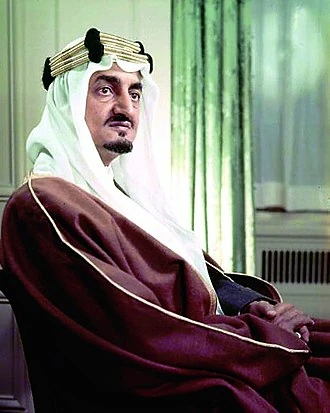
King Faisal of Saudi Arabia
King Faisal bin Abdulaziz Al Saud was the third king of Saudi Arabia, ruling from 1964 until his assassination on March 25, 1975. He played an important role in shaping the kingdom’s government, expanding public education, managing oil revenues, and strengthening Saudi Arabia’s influence in Arab and international affairs. Before becoming king, he spent decades serving as a diplomat, foreign minister, and senior government official.
His reign coincided with major changes across the Middle East, including the 1967 Arab-Israeli war and the 1973 oil crisis. Faisal pursued economic and administrative reforms while maintaining the central role of Islam in Saudi public life. His policies and diplomatic decisions helped define Saudi Arabia’s direction during a period of rapid change.
Who Was King Faisal of Saudi Arabia?
King Faisal was a son of Abdulaziz Ibn Saud, the founder of modern Saudi Arabia. Born in Riyadh in 1906, he entered public service while still young and gained experience in diplomacy, administration, and state affairs before becoming monarch.

King Faisal bin Abdulaziz Al Saud
Third king of Saudi Arabia
Born: 1906, Riyadh
Died: March 25, 1975, Riyadh
Reign: November 1964 to March 1975
Father: King Abdulaziz Ibn Saud
Mother: Tarfa bint Abdullah Al Sheikh
Predecessor: King Saud
Successor: King Khalid
Faisal is remembered for his role in modernizing parts of the Saudi state, promoting education, abolishing slavery, and using oil diplomacy to advance Saudi Arabia’s foreign-policy objectives. His record also reflects the limits of political and social change under a monarchy that retained concentrated royal authority.
Early Life and Family Background
King Faisal was born in Riyadh in 1906, during the period when his father was consolidating the territories that would eventually become the Kingdom of Saudi Arabia. His father, Abdulaziz Ibn Saud, established the modern Saudi state in 1932 and became its first king.
His mother was Tarfa bint Abdullah Al Sheikh, who came from a prominent religious family. She died when Faisal was still an infant, and his maternal grandparents played a major role in his upbringing.
Faisal grew up in an environment where religion, tribal relationships, political alliances, and leadership were closely connected. His education included the Quran, Islamic principles, Arabic reading, writing, and traditional scholarship. His maternal grandfather, Abdullah bin Abdul Latif Al Sheikh, helped shape his religious education.
His upbringing also introduced him to the responsibilities of the royal household. His father was building a state from territories with distinct political and tribal histories, so Faisal witnessed the demands of administration and diplomacy from an early age.
Rather than following a conventional academic path, he learned through religious instruction, royal responsibilities, diplomatic assignments, and direct involvement in government affairs. These experiences prepared him for a career that would eventually place him at the centre of Saudi Arabia’s political development.
Education and Early Preparation for Leadership
Faisal’s education combined Islamic learning with practical training in public affairs. He studied the Quran and Islamic teachings under his maternal grandfather and developed an understanding of the religious traditions that influenced Saudi society.
His father also introduced him to political responsibilities while he was young. In 1919, Faisal travelled to Britain as a representative of his father. The visit gave him early exposure to international diplomacy at a time when the political future of the Arabian Peninsula was still taking shape.
These experiences were significant because Saudi Arabia needed leaders who could manage internal relationships while dealing with foreign governments. Faisal gradually became familiar with negotiations, official correspondence, state visits, and the political interests of other countries.
He did not receive the kind of university education associated with many later political leaders. Instead, his preparation came from religious study, observation, travel, and years of government service.
King Faisal’s Early Political Career
Faisal began assuming major public responsibilities during his father’s campaigns to consolidate control over the Arabian Peninsula. His early work involved both military and administrative duties, giving him experience in managing territories and dealing with local leaders.
In the 1920s, he became closely involved in the affairs of the Hejaz, the western region that includes Mecca and Medina. Following the Saudi conquest of the Hejaz in 1925, Faisal took on a leading administrative role in the region.
His responsibilities extended beyond the royal court. He participated in diplomatic missions, represented Saudi interests abroad, and worked on matters concerning government administration. These assignments helped establish his reputation as one of the senior members of the ruling family.
In 1930, Faisal became Saudi Arabia’s first foreign minister. He held the position for many years, making diplomacy one of the defining parts of his political career.
As foreign minister, he dealt with governments in Europe, the Middle East, and elsewhere. His work covered relations with neighbouring countries, international recognition, economic interests, and the kingdom’s position in a changing global political environment.
In 1945, he represented Saudi Arabia at the conference in San Francisco that established the United Nations. His participation reflected the kingdom’s growing engagement with international institutions after the Second World War.
Faisal also held senior administrative positions and served as prime minister during different periods. By the time his father died in 1953, he had accumulated considerable experience in government, diplomacy, and national administration.
The Relationship Between Faisal and King Saud
After King Abdulaziz died in 1953, his eldest surviving son, Saud, became king, while Faisal served as crown prince. The brothers eventually became involved in a prolonged struggle over the management of the kingdom.
Saudi Arabia was receiving increasing income from oil production, but the government faced financial pressures and disputes over spending and administration. Faisal favoured tighter financial controls and more disciplined government management, while disagreements developed over the king’s use of authority and the direction of state finances.
Faisal became prime minister and gained substantial executive responsibilities during the late 1950s. Although the balance of power changed more than once, the rivalry continued to affect the royal court and government.
Senior members of the royal family became involved in efforts to resolve the dispute. On November 2, 1964, Saud abdicated, and Faisal became king.
The transition marked a major turning point in Saudi history. Faisal inherited a state with substantial oil resources, growing international importance, and significant needs in education, public administration, infrastructure, and economic planning.
King Faisal’s Reign from 1964 to 1975
King Faisal ruled Saudi Arabia for just over a decade. During this period, the government expanded development programmes and strengthened the institutions responsible for public administration.
His priorities included controlling government spending, investing in national development, improving education, and increasing the kingdom’s diplomatic influence. Oil income provided the resources for many of these initiatives, although the benefits and pace of development varied across society.
Faisal’s approach to governing combined economic development with religious conservatism. He supported changes that he believed would strengthen the state while preserving the monarchy and the Islamic foundations of Saudi public life.
His government did not introduce democratic political institutions or give citizens a national electoral system for choosing their rulers. Decision-making remained concentrated within the monarchy and the wider governing establishment.
This combination of administrative change and political continuity is essential to understanding his reign. Faisal sought to strengthen and modernize the state without fundamentally changing its system of royal government.
Economic Reforms and Government Administration
One of Faisal’s main concerns was the management of public money. Saudi Arabia’s oil industry was generating growing revenues, but the government needed more effective institutions to turn that income into lasting development.
Faisal supported stricter financial management and greater attention to government planning. He sought to improve the administration of state funds and reduce wasteful spending.
His government promoted development in areas such as transport, agriculture, industry, public services, and infrastructure. These investments helped lay the groundwork for a broader expansion of the Saudi economy.
Road construction and other infrastructure projects improved connections between communities and supported commercial activity. Development planning also helped the government prepare for the demands of a population that increasingly required schools, hospitals, public utilities, and employment opportunities.
The oil sector remained central to the kingdom’s finances. Faisal’s government worked to strengthen Saudi Arabia’s position in international petroleum affairs, recognising that control over oil policy was important not only for revenue but also for foreign relations.
However, the country remained heavily dependent on oil income. The economic changes of the period did not eliminate the challenges associated with relying on a single major source of government revenue.
Abolition of Slavery in Saudi Arabia
A significant measure associated with Faisal’s political career was the abolition of slavery in Saudi Arabia in 1962, when he was serving as prime minister and held extensive executive powers.
Slavery had existed in the region for generations and was connected to wider historical systems of trade, household labour, and social hierarchy. Ending the institution required government action as well as changes in the administration of society.
The abolition measure formed part of a broader programme of administrative and social reforms announced under Faisal’s leadership. It represented a major legal change in a country where slavery had remained part of social life.
The measure is an important part of his historical record because it changed the legal status of people who had been enslaved. It also illustrates how Faisal’s government pursued selected social changes while retaining the monarchy and the kingdom’s established religious and political institutions.
Education Reforms and the Expansion of Schooling
Education was one of the major areas of development during Faisal’s years in government. Saudi Arabia needed more schools, trained teachers, and educational institutions to prepare its population for an expanding economy and public service.
Faisal supported the expansion of formal education, including the development of educational opportunities for girls. His wife, Iffat bint Mohammed Al Thunayan, also played an important role in promoting girls’ education.
At the time, girls’ schooling faced opposition from some conservative groups. The introduction and expansion of girls’ education therefore required careful negotiation with religious and social authorities.
The government continued to develop schools and educational administration, helping to increase access to formal learning. These efforts were part of a wider shift from an education system dominated by traditional religious instruction toward a broader system that also included subjects needed for modern public administration and professional work.
Education under Faisal did not become separate from religion. Islamic teaching remained important, while the state expanded access to additional subjects and institutions.
The growth of education during his political career contributed to the development of a larger educated population and helped prepare Saudi society for the changes that followed the expansion of the oil economy.
Television and Social Change Under King Faisal
Television became another important issue during Faisal’s years in government. Its introduction generated public debate because some conservative groups considered the new medium culturally or religiously unacceptable.
The government moved forward with television broadcasting in the 1960s, despite opposition from some quarters. The dispute illustrated the tensions that emerged as new technologies entered a society undergoing rapid economic change.
Television was not simply an entertainment issue. It raised wider questions about how Saudi Arabia could adopt modern communications technology while maintaining religious and cultural traditions.
Faisal’s government also encouraged the use of radio, newspapers, and other forms of communication, although these outlets operated under government control.
The debate over television showed that modernization under Faisal did not proceed without resistance. The government introduced selected changes, but it continued to place clear limits on political and media freedoms.
King Faisal’s Foreign Policy
Foreign policy was one of the strongest features of Faisal’s career. Long before becoming king, he had represented Saudi Arabia abroad and managed relations with foreign governments.
As monarch, he sought to increase Saudi Arabia’s influence in the Arab world and among Muslim-majority countries. His diplomatic approach focused on protecting the kingdom’s interests, strengthening regional relationships, and responding to conflicts affecting the Middle East.
Faisal maintained close relations with the United States, particularly because of shared strategic interests and the importance of oil. However, his foreign policy was not simply an extension of American policy. He also pursued Saudi objectives on Palestine, Arab political affairs, and relations among Muslim countries.
His government opposed the expansion of Soviet influence in the region and generally maintained an anti-communist position. At the same time, Faisal worked to improve Saudi Arabia’s relationships with other Arab governments, including countries with which the kingdom had previously experienced serious disagreements.
The 1967 Arab-Israeli war and its aftermath became major influences on his regional diplomacy. The defeat of Arab forces intensified the Palestinian question and affected political relationships across the Middle East.
Faisal supported Palestinian rights and opposed Israeli occupation of Arab territories. His position on these issues influenced Saudi Arabia’s diplomatic relationships and its approach to regional conflicts.
King Faisal and the 1973 Oil Crisis
The 1973 oil crisis was one of the most consequential events of Faisal’s reign. It began during the Arab-Israeli war of October 1973, when several Arab oil-producing countries used petroleum policy as a means of applying political pressure.
Saudi Arabia participated in oil production restrictions and an embargo targeting the United States and other countries viewed as supporting Israel. These actions contributed to a sharp increase in oil prices and major disruptions in international energy markets.
The crisis affected economies around the world. Countries that depended heavily on imported petroleum faced higher energy costs, fuel shortages, inflationary pressures, and economic uncertainty.
For Saudi Arabia, the episode demonstrated the international influence that came with its position as a major oil producer. Petroleum was not merely a source of national income. It could also be used as a diplomatic instrument.
Faisal’s role in the crisis strengthened his international profile, particularly among Arab governments and supporters of the Palestinian cause. However, the oil restrictions also damaged relations with countries affected by the embargo and contributed to economic difficulties beyond the Middle East.
The crisis had consequences that extended beyond Faisal’s lifetime. It highlighted the vulnerability of oil-importing economies and encouraged governments to reconsider energy security, fuel consumption, and the strategic importance of petroleum supplies.
King Faisal’s Relationship with the United States
Saudi Arabia’s relationship with the United States developed over several decades, particularly through oil and security interests. During Faisal’s reign, the relationship remained important, but it was complicated by the Arab-Israeli conflict.
Faisal valued international partnerships that supported Saudi security and economic interests. The United States was an important partner in these areas, and cooperation continued despite disagreements over American support for Israel.
The 1973 oil embargo revealed the limits of the relationship. Faisal’s government was prepared to use oil policy to express opposition to American support for Israel, even though the two countries maintained significant strategic ties.
This episode demonstrates that Saudi foreign policy under Faisal involved balancing relationships rather than following a single power without question. Oil, regional security, religious and political concerns, and the Palestinian issue all influenced his decisions.
King Faisal and the Muslim World
Faisal placed considerable importance on cooperation among Muslim countries. He believed Saudi Arabia’s position as the home of Mecca and Medina gave it a special role in Islamic affairs.
He supported efforts to strengthen communication and cooperation among Muslim-majority states. His diplomacy helped promote the idea that countries with different political systems could work together on issues of shared concern.
The first Islamic Summit Conference, held in Rabat in 1969 after an attack on the Al-Aqsa Mosque compound in Jerusalem, became an important step toward stronger institutional cooperation among Muslim countries. The Organisation of Islamic Cooperation was established in the aftermath of the conference.
Faisal supported the development of closer ties among Muslim governments and the defence of Islamic holy sites. His approach combined religious concerns with practical diplomacy, including the pursuit of alliances and the coordination of international positions.
His role in Islamic diplomacy contributed to Saudi Arabia’s growing visibility beyond the Arabian Peninsula.
King Faisal’s Family, Wife and Children
King Faisal belonged to the House of Saud, the royal family that has ruled Saudi Arabia since the establishment of the modern kingdom.
He married Iffat bint Mohammed Al Thunayan, who became widely known as Queen Iffat in accounts of the royal family. She was involved in educational initiatives, particularly efforts to expand opportunities for girls and women.
Their family included sons and daughters who later held public, charitable, educational, and business roles. One of their sons, Prince Saud Al Faisal, became a prominent Saudi diplomat and served as foreign minister for many years after his father’s death.
Another son, Prince Turki Al Faisal, held senior positions in Saudi intelligence and diplomacy, including serving as ambassador to the United States and the United Kingdom.
King Faisal had children through his marriages, and biographical accounts identify several sons and daughters. Royal family histories sometimes differ in how they present family details, so individual records should be treated carefully when exact dates or complete lists are required.
The family’s involvement in public affairs continued to influence Saudi political and diplomatic life long after Faisal’s death.
How King Faisal Died
King Faisal was assassinated in Riyadh on March 25, 1975, while receiving visitors as part of his official duties. The assailant was his nephew, Prince Faisal bin Musaid.
The killing shocked Saudi Arabia and attracted international attention because the attacker belonged to the royal family. The circumstances prompted investigations into the prince’s background and possible motives.
Prince Faisal bin Musaid was subsequently executed after being convicted for the assassination. Explanations for his actions have included personal and family-related factors, but claims about the full motivation should be approached cautiously because the available historical record does not establish every aspect of the case beyond dispute.
King Faisal’s death ended a reign that had included substantial changes in Saudi administration, education, economic development, and international relations.
He was succeeded by his half-brother, King Khalid, who continued governing a country whose oil revenues and international influence had grown considerably during Faisal’s time in office.
King Faisal’s Legacy
King Faisal’s legacy is closely connected to the development of the modern Saudi state. His years in public service and his reign coincided with major changes in government administration, education, infrastructure, and the kingdom’s role in global affairs.
His support for education helped expand formal schooling, including opportunities for girls. The abolition of slavery in 1962 was another major legal change associated with his leadership as prime minister.
In economic affairs, Faisal promoted more disciplined government administration and supported development projects as oil income increased. His government also helped strengthen Saudi Arabia’s position in international petroleum diplomacy.
His influence was especially visible in foreign policy. The 1973 oil crisis demonstrated the extent to which Saudi Arabia could affect international energy markets, while his efforts to build relationships across the Muslim world expanded the kingdom’s diplomatic reach.
His legacy is not without complexity. Political authority remained concentrated in the monarchy, the press operated under government restrictions, and the reforms introduced during his time did not establish a democratic system. His government pursued modernization in selected areas while preserving the kingdom’s established political structure.
Even with these limitations, Faisal remains a major figure in Saudi history because of the combination of administrative reform, educational development, religious conservatism, and international diplomacy that characterised his career.
Conclusion
King Faisal of Saudi Arabia was a monarch whose influence extended well beyond the years he spent on the throne. His early experience as a diplomat and government official prepared him to lead a country undergoing rapid economic and political change.
During his reign from 1964 to 1975, he supported education, promoted administrative reform, and strengthened Saudi Arabia’s international role. His involvement in the 1973 oil crisis showed how petroleum could become a central instrument of foreign policy, while his diplomacy helped increase cooperation among Muslim countries.
His assassination in 1975 brought his rule to an abrupt end, but the institutions, policies, and international relationships shaped during his lifetime continued to affect Saudi Arabia. Understanding Faisal requires looking at both the changes he supported and the political system he preserved.
Frequently Asked Questions About King Faisal of Saudi Arabia
1. Who was King Faisal of Saudi Arabia?
King Faisal bin Abdulaziz Al Saud was the third king of Saudi Arabia. He ruled from November 1964 until his assassination on March 25, 1975. Before becoming king, he served as foreign minister, prime minister, and crown prince.
2. When was King Faisal born?
King Faisal was born in Riyadh in 1906. He was a son of King Abdulaziz Ibn Saud, the founder of modern Saudi Arabia, and Tarfa bint Abdullah Al Sheikh.
3. How long did King Faisal rule Saudi Arabia?
Faisal ruled Saudi Arabia for just over ten years, from November 2, 1964, until March 25, 1975.
4. Who was King Faisal’s father?
His father was Abdulaziz Ibn Saud, who established the modern Kingdom of Saudi Arabia in 1932 and served as its first king.
5. What were King Faisal’s major achievements?
His major achievements included supporting the expansion of education, promoting government financial reforms, advancing development projects, helping bring about the abolition of slavery in 1962 while serving as prime minister, and strengthening Saudi Arabia’s international influence.
6. What role did King Faisal play in the 1973 oil crisis?
Faisal’s government participated in oil production restrictions and an embargo against the United States and other countries seen as supporting Israel during the 1973 Arab-Israeli war. The measures contributed to a sharp increase in oil prices and disrupted global energy markets.
7. Who was King Faisal’s wife?
One of his best-known wives was Iffat bint Mohammed Al Thunayan, who supported educational initiatives, including the expansion of education for girls in Saudi Arabia.
8. How did King Faisal die?
King Faisal was assassinated in Riyadh on March 25, 1975, by his nephew, Prince Faisal bin Musaid.
9. Who succeeded King Faisal?
His half-brother King Khalid succeeded him in 1975 and became the fourth king of Saudi Arabia.
10. Why is King Faisal remembered today?
He is remembered for his role in developing Saudi government institutions, supporting educational expansion, promoting administrative reform, and increasing the kingdom’s influence in international diplomacy and oil policy.